
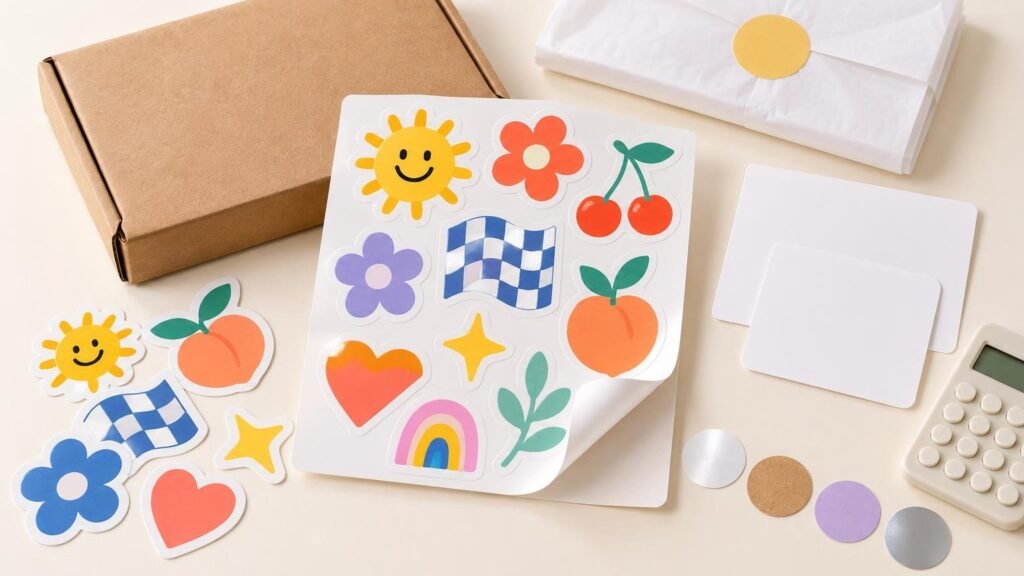
TLDR: There is no universal answer to how much does it cost to start a sticker business. An outsourced launch can begin with a small print order, basic packaging, and an existing selling channel, avoiding the cost of a printer and cutting machine. Your useful startup number is the total of inventory, artwork, packaging, selling fees, fulfillment supplies, promotion, administrative obligations, and a cash buffer—not merely the advertised price per sticker.
The biggest decision is whether to outsource production or buy equipment. For a first launch, outsourcing usually creates the simpler budget: choose one to three proven designs, order a test quantity, inspect the proof, and learn what sells before committing cash to machinery or deep inventory. In-house production can provide more control later, but it adds equipment, materials, maintenance, workspace, waste, and production labor.
Build your sticker business startup budget
The Small Business Administration’s business-planning resources identify startup categories such as inventory, equipment and supplies, licenses and permits, advertising, websites, printed materials, and professional services. The SBA also recommends separating one-time expenses from recurring monthly costs. That distinction prevents a small first print order from making the whole launch look cheaper than it really is.
| Budget category | What may belong in it | Cost-control question |
|---|---|---|
| Sticker inventory | Printed stickers, sheets, packs, labels, samples and overruns | Can you test fewer designs or a smaller quantity first? |
| Artwork | Illustration, logo cleanup, vector conversion, typography and design revisions | Is your existing artwork ready at final print size? |
| Packaging | Sleeves, bags, backing cards, toppers, mailers and protective material | Does the packaging improve the product enough to justify its cost? |
| Selling | Marketplace fees, payment processing, website costs and event fees | Can you begin on an existing channel before building a larger store? |
| Fulfillment | Postage, labels, mailers, tape and order inserts | What does one complete packed order cost to ship? |
| Promotion | Product photos, samples, displays, ads and creator outreach | Which activity can be measured against actual sales? |
| Administration | Registration, permits, tax help, insurance and bookkeeping | Which obligations apply in your location and selling channel? |
| Buffer | Reprints, damaged stock, refunds and an earlier-than-expected reorder | How much cash must remain available after launch? |
Do not assume every category requires a purchase on day one. A creator who already has finished artwork, takes product photos with available equipment, and sells through an established marketplace has a different starting point from a brand commissioning illustrations, launching a standalone store, and buying event inventory.
What changes the cost of your first sticker order?
A printer quote reflects a production configuration. To compare quotes responsibly, keep the size, quantity, material, finish, shape, number of designs, packaging, and shipping method consistent. Otherwise, a low headline price may describe a materially different product.
Size and shape
Larger stickers consume more material and package differently. An intricate contour can also change how the finished sticker looks and how easily it peels. Before ordering, print the design on ordinary paper at its intended physical size. This catches tiny text and crowded details without consuming production inventory. If you are uncertain about dimensions, use a sticker size guide before requesting quotes.
Quantity and number of designs
Higher quantities often improve the quoted unit economics, but unsold stock has a real cost. Ten designs ordered deeply can tie up much more cash than two designs tested in modest quantities. Start from a sales plan—online launch, market table, wholesale pitch, or order insert—rather than choosing the quantity with the most attractive discount. The guide to choosing a first sticker quantity provides a more detailed demand-based approach.
Design count can create separate setup or handling costs. YouStickers’ published FAQ says the first two designs are free on standard custom sticker products and lists a $3 charge for each additional design under that policy. Confirm the live terms for your order before treating that figure as fixed.
Material, laminate, and product format
Standard vinyl, clear material, holographic material, chrome effects, sheets, rolls, and assembled packs are not interchangeable. A specialty base may support a higher retail price, but only if the effect matters to the customer and the artwork is built for it. Clear, chrome, and holographic designs may also require deliberate white-underprint decisions so selected colors remain opaque while uncovered areas show the base material.
Choose the delivery format around the product. Individually cut stickers suit singles and creator merchandise. Sheets group several designs on one backing. Roll labels are oriented toward repeat packaging application rather than selling each piece as merchandise. Packs add presentation and bundling work: YouStickers states that its custom sticker-pack product includes bags, bag toppers, and assembly, while the stickers themselves are purchased separately.
Proofing and shipping
A proof is a production checkpoint, not a decorative preview. Confirm the final dimensions, contour cutline, border consistency, orientation, important text clearance, transparency, and intended specialty effect. YouStickers states that it supplies an online proof, can create the cutline, and permits proof-stage revisions before printing. Catching an incorrect size or cutline here is less expensive than discovering it across an entire finished run.
Include shipping in the delivered inventory cost. YouStickers publishes economy, standard, and paid UPS options, but processing and transit are addressed separately and can change. When comparing outsourced printers such as Custom Stickers, compare the final delivered total and estimated arrival—not only the product subtotal.
A practical way to estimate the first launch
Begin with one to three designs and collect a quote for the exact size, material, finish, and quantity you intend to sell. As one time-sensitive illustration, YouStickers has displayed 50 three-inch stickers for $19.99 on its custom-sticker page. That promotional configuration is not a general unit price or a complete business budget, so verify the live page and checkout before relying on it.
- Add the delivered cost of your printed inventory, including shipping and any design-related charges.
- Add packaging and fulfillment supplies needed to make every unit sellable and shippable.
- Estimate channel costs such as payment processing, marketplace charges, website expenses, or event fees.
- Add launch-specific artwork and promotion expenses.
- Set aside a buffer for damaged stock, refunds, reprints, or a faster-than-expected reorder.
- Divide the applicable total by the number of sellable units—not simply the number printed.
For example, if a pack contains three stickers, calculate the print and packaging cost of the complete pack. Do not call the price of one component your product cost. Likewise, allocate a backing card, sleeve, marketplace fee, and expected packing material to the product when those expenses occur with each sale.
Calculate unit cost and break-even
Use two related calculations. Fully loaded unit cost helps with pricing; break-even shows how many units must sell before the launch has covered its fixed costs.
- Variable cost per sellable unit = printing + per-unit packaging + transaction-related costs + other costs that rise with each unit sold.
- Contribution margin per unit = selling price − variable cost per unit.
- Break-even units = fixed launch costs ÷ contribution margin per unit.
Suppose artwork and event registration are fixed costs. Sticker printing, sleeves, and transaction fees may be variable costs. If shipping is charged separately to the buyer, keep that treatment consistent in both your revenue and cost assumptions. The SBA recommends using fixed costs, selling price per unit, and variable cost per unit in break-even planning.
Run the calculation before ordering a larger batch. A lower printing cost per sticker does not necessarily produce a better launch if the quantity requires far more sales to recover the cash committed. Treat bulk ordering as a demand decision, not merely a discount opportunity.
Prepare artwork that does not create avoidable expense
YouStickers recommends raster artwork at 300 DPI at the final physical size and identifies vector files as preferable for scalable logos and crisp text. Final size is essential: an image that is adequate at two inches wide may not remain adequate when enlarged.
PNG is useful when raster artwork needs transparency, while JPG does not preserve transparent areas. Vector formats such as SVG, AI, and suitable PDFs are often better for logos, text, and clean shapes. Before upload, check spelling, outline or embed fonts where appropriate, and remove unintended background pixels. Clean source artwork can reduce revision cycles and make size changes easier.
When should you consider in-house production?
Buy equipment because the expected volume, turnaround needs, and control justify it—not because a home printer appears to make each sticker free. An in-house budget may include a printer, cutter, ink, printable media, laminate, cutting mats or blades, color-management work, maintenance, failed prints, workspace, packing supplies, and production labor.
Equipment can also have tax and accounting consequences. The IRS explains that business assets with a useful life extending beyond one year are generally recovered over time through depreciation rather than automatically treated as an ordinary current expense. A tax professional can help determine how the rules apply to your equipment and business structure.
Outsourcing remains attractive when you want to validate demand, avoid maintenance, or use materials and finishing processes that would be cumbersome to reproduce at home. In-house production becomes more plausible when sales are steady enough to measure, rapid experimentation matters, and you can assign a realistic value to your production time.
Frequently asked questions
Can I start a sticker business without a printer or cutting machine?
Yes. You can create or commission the artwork, outsource printing and cutting, and focus on product selection, sales, packing, and customer service. This is often the cleanest way to test demand before buying equipment.
How many stickers should I order first?
Order enough to test your actual sales channel without creating uncomfortable unsold inventory. A known event audience may justify more stock than a new online shop with no sales history. Favor a smaller run when the design, price, or audience is still uncertain.
Does ordering more lower the cost per sticker?
It often can, but the delivered quote is what matters. Compare identical configurations and calculate how many units must sell to recover the larger upfront order. Unit savings are not useful if the remaining inventory becomes obsolete or never sells.
Do I need a license, sales-tax registration, or insurance?
Requirements depend on your location, business structure, products, and sales channels. Check the official state and local agencies that govern your business rather than assuming a marketplace handles every obligation. Treat registration, tax support, bookkeeping, and insurance as budget categories until you know which ones apply.
What should I do next?
Choose one sellable format, finalize one to three designs, and request an exact delivered quote. Add packaging, selling, fulfillment, promotion, and administrative costs; then calculate contribution margin and break-even units. That number—not the cheapest advertised sticker—is the realistic answer to what your sticker business will cost to start.
References
- Plan your business – Small Business Administration
- Frequently Asked Questions – YouStickers
- Custom Sticker Packs – YouStickers
- Custom Sticker Printing | Quality Vinyl | YouStickers
- Shipping Policy – YouStickers
- Artwork Guideline Checklist – YouStickers
- Publication 583 (12/2024), Starting a Business and Keeping Records | Internal Revenue Service
