
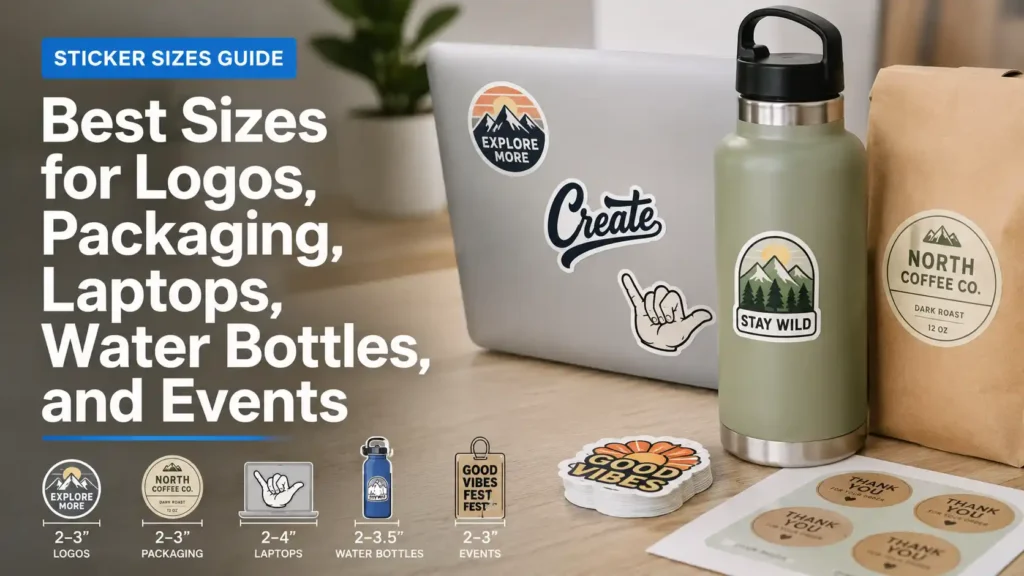
TLDR
- The best sticker size depends on where the sticker will go, not just how the design looks on screen.
- A 2″ to 3″ sticker is the safest all-purpose size for logos, giveaways, laptops, water bottles, and merch.
- Packaging labels usually need to match the container, jar, pouch, box, or bottle rather than follow one universal size.
- Small text, QR codes, and detailed artwork usually need a larger sticker to stay readable.
- When in doubt, print the design slightly larger or simplify the artwork before shrinking it.
Choosing sticker sizes is one of the easiest places to make a design better before it ever goes to print. A logo that looks clean at 4 inches wide might become cramped at 1.5 inches. A water bottle sticker may need to curve around the bottle. A packaging label may need room for a product name, scent, flavor, barcode, ingredients, or QR code.
This sticker sizes guide gives you practical starting points for common uses: logos, packaging, laptops, water bottles, events, giveaways, product labels, and small business branding. The goal is not to force every project into one “perfect” size. The goal is to help you choose a size that fits the surface, keeps the design readable, and makes ordering easier.
Common Sticker Sizes at a Glance
| Sticker Use | Common Size Range | Best Starting Size |
|---|---|---|
| Small logo stickers | 1.5″ to 2.5″ | 2″ |
| General logo handouts | 2″ to 3″ | 3″ |
| Laptop stickers | 2″ to 4″ | 3″ |
| Water bottle stickers | 2″ to 3.5″ | 3″ |
| Packaging stickers | 1″ to 4″ | Depends on container |
| Jar and candle labels | 2″ to 3.5″ wide | 2.5″ or 3″ |
| Event giveaways | 2″ to 3″ | 3″ |
| Bumper stickers | 3″ x 8″ to 4″ x 10″ | 3″ x 8″ |
| QR code stickers | 1.25″ and up | 1.5″ to 2″ |
| Sticker sheets | 4″ x 6″ to 5″ x 7″ | 4″ x 6″ |
These are starting points, not hard rules. A simple icon can work smaller. A detailed illustration, long business name, or label with fine print usually needs more space.
Best Sticker Sizes for Logos
For most logo stickers, 2″ to 3″ is the sweet spot. This size is large enough to see the brand clearly but small enough to work as a handout, package insert, laptop sticker, or water bottle sticker.
A 2″ logo sticker works well when the design is simple: an icon, badge, initials, mascot head, or short wordmark. A 3″ logo sticker is better when the design includes a longer business name, a slogan, a circular badge, or small supporting text.
Use these logo sizing rules:
- Choose 1.5″ to 2″ for simple icons, seals, and small packaging extras.
- Choose 2.5″ to 3″ for most business logo stickers.
- Choose 3″ to 4″ for detailed logo art, merch, or designs meant to be noticed from farther away.
- Avoid going too small when the logo has thin lines, distressed texture, tiny letters, or a long horizontal layout.
Logo shape matters too. A round logo usually works well as a 2″ or 3″ circle. A long horizontal logo may need a wider rectangle, such as 2″ x 4″, so the text does not feel squeezed. A die cut logo can follow the artwork shape, but you still need enough width and height for the smallest details to print clearly.
YouStickers offers custom stickers in custom sizes and shapes, with proofs before production, which is useful when you are not sure how the cutline or final size will look.
Best Sticker Sizes for Packaging
Packaging stickers and labels should be sized around the package first and the artwork second. A sticker for a bakery box, pouch, jar, bottle, candle tin, shipping mailer, or product bag has to look balanced on the actual container.
For small packaging, 1.5″ to 2.5″ is often enough. For front-facing product labels, 2″ to 4″ is more common. For jars, candles, bottles, and retail packaging, the right size depends on how much information needs to fit.
Good starting sizes include:
| Packaging Type | Useful Sticker or Label Size |
|---|---|
| Small product boxes | 1.5″ to 2.5″ |
| Bakery boxes | 2″ to 3″ circle or square |
| Coffee bags | 2″ x 3″, 3″ x 4″, or 4″ x 4″ |
| Candle jars | 2″ to 3″ wide front label |
| Lip balm tubes | Narrow wrap label |
| Small jars | 2″ circle or 2″ x 2″ square |
| Large jars | 2.5″ to 3.5″ front label |
| Shipping mailers | 2″ to 4″ logo or thank-you sticker |
For packaging, the sticker’s job matters. A thank-you sticker can be small and simple. A product label needs more room because it may include the product name, scent or flavor, net weight, ingredients, barcode, QR code, batch information, or usage details.
If you are labeling many packages by hand, roll labels are often easier to apply in batches than individual stickers. YouStickers describes stickers as a better fit for merch, handouts, events, and brand visibility, while labels are more packaging-focused for bottles, jars, boxes, retail goods, and repeat application.
Best Sticker Sizes for Laptops
Laptop stickers usually work best between 2″ and 4″. A 3″ sticker is the safest standard choice because it feels substantial without taking over the whole laptop.
Use smaller sizes when customers are likely to collect several stickers on the same laptop. Use larger sizes when the design is meant to stand alone.
Good laptop sticker sizes:
- 2″ for small icons, mini logos, and simple artwork
- 2.5″ to 3″ for most brand stickers, creator merch, and logo giveaways
- 3.5″ to 4″ for statement stickers, detailed illustrations, mascots, and large badges
- 2″ x 4″ for horizontal wordmarks or slogan stickers
Laptop stickers are viewed up close, so small details can work better than they would on a car window or event sign. Still, tiny text can become a problem. If a laptop sticker has a website, tagline, or social handle, order a physical size that lets the text breathe.
For laptop use, laminated vinyl is usually a better choice than a basic paper sticker because laptops are handled often, slid into bags, and touched regularly. YouStickers lists durable vinyl, matte or gloss laminate, and custom shapes as part of its custom sticker offering.
Best Sticker Sizes for Water Bottles
Water bottle stickers usually work best between 2″ and 3.5″. A 3″ sticker is the best general starting point for reusable bottles because it is easy to see, easy to hold, and not too large for curved surfaces.
The main issue with water bottles is curvature. A very wide sticker can wrinkle or lift at the edges if the bottle has a tight curve, textured surface, taper, ridge, or grip pattern. Taller, narrower designs can sometimes fit better than wide rectangles.
Good water bottle sticker sizes:
| Design Type | Suggested Size |
|---|---|
| Simple icon | 2″ |
| Standard logo | 2.5″ to 3″ |
| Badge or mascot | 3″ |
| Tall vertical design | 2″ x 3″ |
| Horizontal logo | 1.5″ x 3″ or 2″ x 4″ |
| Small product bottle label | Depends on bottle diameter |
For reusable water bottles, a laminated white vinyl sticker is often the safer choice because it keeps colors readable and handles regular use better than an uncoated paper sticker. YouStickers’ water bottle material guide recommends laminated white vinyl for most reusable bottle stickers and points to BOPP roll labels for bottled products being sold.
Clear stickers can look great on bottles, but they are more dependent on the surface color. A clear sticker with dark ink may disappear on a dark bottle. A white vinyl sticker gives the design its own background, which usually improves readability.
Best Sticker Sizes for Events and Giveaways
For events, giveaways, conventions, trade shows, school events, fundraisers, markets, and local promotions, 2″ to 3″ stickers are usually the best choice. They are large enough to feel worth keeping but small enough to hand out easily.
A 3″ sticker is the safest event giveaway size. It works for logos, badges, mascots, short slogans, and simple illustrations. It also fits well in baskets, swag bags, vendor booths, mailers, and checkout counters.
Use these event sizing guidelines:
- Choose 2″ for small budget-friendly handouts or kids’ event stickers.
- Choose 2.5″ to 3″ for the best all-around giveaway size.
- Choose 3″ to 4″ for premium merch, artist stickers, or designs meant to be sold.
- Choose sticker sheets when you want several small designs in one handout.
- Choose kiss cut stickers when easy peeling matters.
For events, the design should be instantly understandable. People may glance at it for only a second. A simple shape, bold logo, readable phrase, or strong character usually works better than a crowded layout.
Best Sticker Sizes for QR Codes
QR code stickers need enough size and contrast to scan reliably. A very small QR code may technically work in ideal conditions, but it can fail in dim light, at an angle, behind glare, or when printed with low contrast.
For close-range scanning, start around 1.5″ to 2″ if the sticker also includes a label, short instruction, or logo. Nielsen Norman Group notes that while 1 cm x 1 cm is sometimes cited as an official minimum, that size can be too small for reliable scanning, and recommends aiming for at least 2 cm x 2 cm for better results.
For sticker design, that means:
- Avoid shrinking QR codes too aggressively.
- Keep strong contrast between the code and background.
- Leave a quiet zone around the QR code.
- Test scan the proof at actual size before ordering.
- Use a larger sticker when the QR code will be scanned from farther away.
A QR code sticker that also includes “Scan for menu,” “Leave a review,” or “Join our rewards list” usually needs more space than the code alone.
Best Sticker Sizes for Small Text
Small text is one of the biggest reasons to size up. A sticker may look fine on a screen because you are zoomed in, but the printed piece will be viewed at actual size.
As a practical rule, avoid tiny text on stickers under 2″. If the design needs a website, social handle, ingredients, directions, or legal copy, increase the sticker size or simplify the layout.
Small text works best when:
- the font is clean and not too thin
- the text has strong contrast
- there is enough space between letters
- the text is not too close to the cutline
- the sticker is large enough to read at normal viewing distance
For print quality, raster artwork should be high resolution at the final print size. Adobe’s print guidance recommends a minimum of 300 DPI for best print quality. Vector files such as AI, SVG, or clean PDFs are often better for logos because they can scale without becoming blurry.
How to Choose the Right Sticker Size
Start with the surface, then check the design.
Ask these questions before ordering:
- Where will the sticker be applied?
- Is the surface flat, curved, small, textured, wet, handled often, or disposable?
- Will the sticker be viewed up close or from a distance?
- Does the design include small text?
- Does the sticker need to include a QR code, barcode, ingredients, or instructions?
- Is the sticker meant to be kept, sold, handed out, or used as packaging?
- Would the design still make sense if it were smaller?
If the sticker is for merch or giveaways, 3″ is usually the best first size. If the sticker is for packaging, measure the package before choosing. If the sticker includes important text, print a paper mockup at actual size and check readability before ordering.
Practical Recommendations by Use Case
For a simple logo sticker, choose 2.5″ to 3″. That size works for laptops, bottles, packaging inserts, event tables, and general brand handouts.
For small packaging, start with 2″ circles, 2″ squares, or 2″ x 3″ labels. Adjust based on the container and amount of text.
For water bottles, choose a 3″ vinyl sticker unless the bottle is narrow or heavily curved. For narrow bottles, consider a 2″ to 2.5″ design or a taller vertical layout.
For events, choose 3″ stickers if you want one reliable giveaway size. Choose sticker sheets when the event needs multiple designs, characters, icons, or themed mini stickers.
For QR code stickers, do not chase the smallest possible size. Use 1.5″ to 2″ or larger when the code needs to scan easily and include a short call to action.
For detailed artwork, size up. A 4″ sticker can make sense for illustrations, mascots, maps, badges, and art prints that would lose detail at 2″.
Common Sticker Size Mistakes
Choosing the size before choosing the surface
A 4″ sticker may look great on a laptop but feel too large on a small jar or curved bottle. Measure the actual surface before ordering.
Making logo text too small
Long business names, slogans, and small taglines often need more room than expected. If the text is important, do not bury it in a tiny sticker.
Ignoring the cutline
Die cut stickers need space around the artwork. Keep important text and details away from the edge so the design does not feel cramped.
Using the same size for every product
A candle label, coffee bag sticker, water bottle sticker, and laptop sticker may all need different sizes. One standard brand sticker is useful, but packaging should be sized to the package.
Shrinking QR codes too much
QR codes need enough physical size, contrast, and quiet space to scan. Always test the code at actual size.
Designing only on screen
Screens make artwork look larger than it really is. Print the design on paper at actual size before approving the sticker size.
FAQs
What is the most popular sticker size?
A 3″ sticker is one of the most useful all-purpose sizes. It works well for logos, laptops, water bottles, giveaways, packaging inserts, and merch.
What size should a logo sticker be?
Most logo stickers should be 2″ to 3″. Use 2″ for simple icons and 3″ for business logos, badges, mascots, or designs with supporting text.
What size is best for laptop stickers?
Laptop stickers usually work best between 2″ and 4″. A 3″ sticker is the safest starting point for most logos and artwork.
What size sticker is best for water bottles?
A 3″ sticker is a strong starting point for most reusable water bottles. Use a smaller size or narrower design for curved, narrow, tapered, or textured bottles.
What size should packaging stickers be?
Packaging stickers should match the product container. Small boxes and bags may only need 1.5″ to 2.5″ stickers, while jars, candles, bottles, and pouches may need 2″ to 4″ labels depending on the design.
Are bigger stickers always better?
No. Bigger stickers are easier to read, but they may not fit the surface well. The best sticker size is large enough to read and small enough to look natural where it will be applied.
