
TLDR
- Custom roll labels are best for bottles, jars, boxes, pouches, tins, mailers, and other packaging that needs the same label applied repeatedly.
- Choose matte labels for a softer, low-glare appearance; glossy labels for brighter color and shine; and clear labels when the container should remain visible.
- Measure the actual package instead of choosing a label size from the artwork alone.
- Confirm roll direction and other applicator requirements before ordering labels for machine application.
- Apply labels to clean, dry, smooth surfaces using firm, even pressure.
A label that looks good on a computer screen can still be frustrating in production if it is the wrong size, difficult to peel, poorly matched to the container, or supplied in a format that slows down application.
Custom roll labels solve the workflow problem. Instead of sorting through individual pieces, businesses receive labels on a continuous liner that is easier to store, dispense, and apply. The format is especially useful when the same design must be placed on hundreds or thousands of products.
What Are Custom Roll Labels?
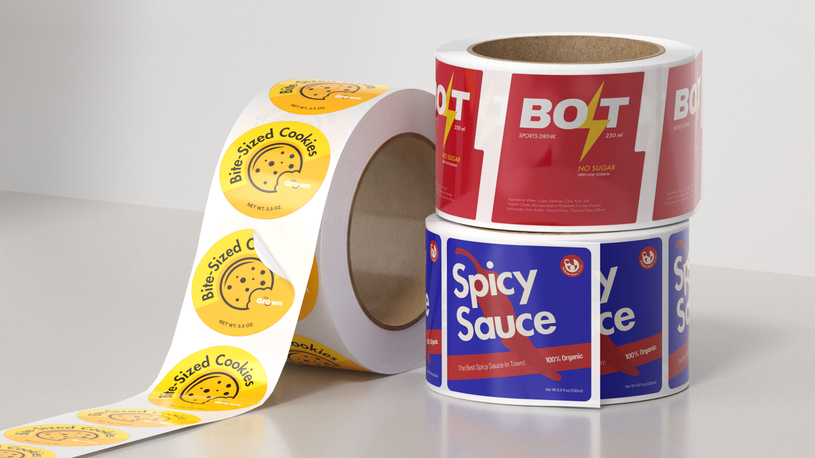
Custom roll labels are pressure-sensitive labels supplied on a continuous roll rather than as separate sticker singles or a flat sheet.
Each label is cut to its finished shape but remains attached to the release liner until it is peeled away. The roll can be used by hand, placed in a simple dispenser, or loaded into compatible labeling equipment.
People often use terms such as sticker rolls, stickers on a roll, roll stickers, and custom roll labels interchangeably. The practical distinction is how the printed pieces will be used.
Roll labels are usually built around a packaging workflow:
- Applying logo labels to product boxes
- Labeling candle jars or cosmetic containers
- Adding ingredients or directions to bottles
- Sealing bags, tissue paper, or mailers
- Identifying product varieties
- Adding barcodes or QR codes
- Applying the same design repeatedly
Individual stickers are generally better for handouts, merch, laptops, giveaways, or packaging inserts. For a direct comparison, see Roll Labels vs Sticker Sheets: Which Is Better for Product Packaging?.
YouStickers currently offers custom roll labels in multiple shapes and packaging-focused finishes, including matte, glossy, clear, round, square, oval, rectangle, product-label, and custom die-cut options.
When Should a Business Use Sticker Rolls?
Roll labels make the most sense when application is repetitive.
If you are applying one label to 500 jars, pulling each label from a roll is usually easier than handling 500 loose pieces. The labels stay in order, take up less worktable space, and can be positioned near the person packing the products.
| Business Need | Recommended Format |
|---|---|
| Labeling a repeated product line | Roll labels |
| Applying labels with a dispenser | Roll labels |
| Labeling bottles, jars, tins, or pouches | Roll labels |
| Including a free logo sticker inside an order | Individual stickers |
| Selling designs as merch | Sticker singles, sheets, or packs |
| Printing several small designs together | Sticker sheets |
| Handing stickers out at an event | Individual stickers |
| Applying the same barcode repeatedly | Roll labels |
A small batch does not automatically require sticker singles. The better question is whether the label belongs on the product or is meant to become a standalone item.
A branded circle sealing tissue paper is functioning as a label. A durable logo sticker that the customer can place on a laptop is functioning as a sticker.
Choose the Right Roll Label Material and Finish
The best custom roll label material depends on the package, the design, and the conditions the finished product may encounter.
Matte Roll Labels
Matte roll labels have a softer, lower-glare appearance. They are a good fit for candles, soaps, coffee packaging, natural products, skincare, specialty foods, and designs that use muted colors or understated branding.
Matte is often the safer choice when:
- The package will be viewed under bright retail lighting
- The design contains substantial small text
- You want a softer or more natural presentation
- Batch numbers or dates may need to be written by hand
- Photography glare is a concern
Some matte materials accept pen or marker better than glossy materials, but test the exact writing tool before building handwritten information into the workflow. YouStickers’ current matte-label page identifies BOPP as the face material and describes its lower-glare appearance.
Glossy Roll Labels
Glossy labels reflect more light and can make contrast and saturated colors feel stronger. They work well for beverage packaging, colorful food products, bold logos, children’s products, promotional packaging, and designs that are intended to look bright.
Gloss is usually a good choice when:
- Color impact matters more than glare reduction
- The package already has a polished or reflective finish
- The design uses photographs or bright illustrations
- You want a smooth, shiny appearance
Gloss can also make fingerprints and reflections more noticeable. That may not matter on a pouch or shipping box, but it can matter on a cosmetic jar photographed at close range.
Clear Roll Labels
Clear roll labels allow the package itself to remain visible. They can create a clean, printed-on-container appearance on glass bottles, transparent jars, smooth plastic, or metal.
Clear labels work best when:
- The container is part of the design
- The product color should remain visible
- The artwork has strong contrast
- The label will be applied to a smooth surface
- You have tested the artwork against the actual container color
Clear material is less forgiving than white material. Transparent areas reveal everything underneath, including product color, package texture, seams, bubbles, and slight application errors. Printed colors may also appear different when the background is not white.
Do not choose clear labels simply because they sound more refined. Choose them because the package and artwork are designed to work together.
Paper Labels
Paper labels can work for dry, indoor packaging where moisture, oils, rubbing, and refrigeration are limited. They may be appropriate for envelopes, dry boxes, temporary packaging, or short-term event use.
They are generally less forgiving around water and repeated handling than film-based label materials. Confirm the actual material and its intended environment before ordering.
For a closer look at one common film material, read BOPP Labels Explained: Why Small Businesses Use BOPP for Product Labels.
How to Choose the Right Roll Label Size
Measure the package, not just the available design space in your file.
A three-inch logo does not necessarily need a three-inch label. The finished size must also account for the shape of the container, the readable distance, the amount of required information, and the way the label will be applied.
Make a Paper Test Label
Before ordering:
- Print the design on ordinary paper at actual size.
- Cut around the proposed label shape.
- Tape or temporarily place it on the package.
- View it from the front, side, and typical customer distance.
- Check whether the text is readable.
- Confirm that the label does not cross a ridge, seam, corner, or sharp curve.
This ten-minute test can prevent an entire run of labels that look oversized, undersized, or crooked on the finished package.
Watch for Container Curves
Cylindrical bottles and straight-sided jars are usually easier to label than tapered cups, shoulders, squeeze tubes, or compound curves.
A wide label can wrinkle or lift when a container narrows toward the top or bottom. On a strongly tapered package, a smaller front label may work better than a large wraparound design.
Leave Space Around Barcodes and QR Codes
Do not squeeze a barcode into the final corner of the design. GS1 advises keeping retail barcodes away from package edges, surrounding them with adequate clear space, and placing them on a smooth area that will not interfere with scanning. Test the code from a printed sample on the actual package before approving a large order.
Standard Shapes vs Custom Die-Cut Labels
Standard shapes are usually the simplest choice:
- Circle labels for lids, seals, logos, and jars
- Square labels for front-facing branding
- Rectangle labels for ingredients, directions, addresses, and barcodes
- Oval labels for bottles, candles, and specialty products
- Rounded rectangles for clean packaging layouts
A custom die-cut label follows the contour of the artwork or creates a non-standard silhouette. It can make a package more distinctive, but complicated shapes are not always easier to apply.
Thin points, narrow extensions, deep inward corners, and intricate edges can be harder to peel and align. For products moving quickly through a packing line, a simpler shape may save more time than an elaborate shape adds in visual interest.
Hand Application vs Label Dispensers and Applicators
Roll labels do not require a machine. Many small businesses apply them by hand directly from the roll.
A tabletop dispenser can help keep the roll controlled and present each label edge more consistently. This can reduce time spent searching for the peel edge.
Automated or semi-automated application introduces additional requirements. Before ordering, confirm:
- Label width and height
- Gap between labels
- Roll direction or unwind position
- Core dimensions
- Maximum roll diameter
- Whether labels are wound inside or outside
- Whether the applicator needs a specific leading edge
Do not assume every roll will feed through every machine. If an applicator is already part of your production line, send its requirements to the printer before approving the order.
Prepare Artwork for Custom Roll Labels
A strong roll-label design must work at its actual printed size.
Keep Important Content Away From the Edge
Logos, small text, barcodes, borders, and required information should sit inside the safe zone. Minor cutting movement is normal in custom print finishing, so critical content should not depend on perfectly exact edge placement.
Add Bleed
Artwork that reaches the finished edge should extend beyond the cutline. This extra printed area is called bleed and prevents thin unprinted edges from appearing after cutting.
Use Readable Text
Zooming in on a monitor can make tiny lettering appear easier to read than it will be on a two-inch label. Print the design at actual size and read it under ordinary lighting.
Build Variants Carefully
Products with different scents, flavors, sizes, ingredients, or batch information should have clearly named files. “Final-label-new-2” is not a reliable production system.
Use names such as:
- Lavender-8oz-Front
- Cedar-8oz-Front
- Lavender-Ingredients
- Cedar-Ingredients
Review every variant rather than assuming that only the product name changed.
Apply Roll Labels to a Clean, Dry Surface
Pressure-sensitive adhesive needs good contact with the package.
Remove dust, oil, condensation, and loose debris before application. Apply the label with firm, even pressure across its full surface rather than pressing only the center.
3M’s pressure-sensitive adhesive application guidance explains that clean, dry surfaces and firm, even pressure help adhesive develop better contact. It also notes that cold surfaces can reduce initial tack because the adhesive becomes firmer. The exact temperature range varies by adhesive, so product-specific instructions should take priority.
Avoid labeling:
- Containers that are visibly wet
- Cold bottles covered in condensation
- Dusty cardboard
- Oily jars
- Textured surfaces that prevent full contact
- Flexible packages while they are folded or wrinkled
When possible, label containers before they are refrigerated or exposed to moisture.
Store Unused Label Rolls Correctly
Keep unused rolls in their original boxes or protective packaging until needed. Store them in a clean, dry indoor area away from direct sunlight, dust, excessive heat, and large humidity swings.
Avery Dennison’s guidance for finished pressure-sensitive label rolls recommends keeping finished rolls protected from moisture, light, dirt, and dust. It also warns against storing rolls directly on concrete floors, where moisture can migrate into the material.
Use older rolls before newer rolls and inspect stored labels before putting them back into production.
Custom Roll Label Ordering Checklist
Before placing an order, confirm:
- The exact container or package
- Finished label width and height
- Standard or custom shape
- Matte, glossy, clear, or another available material
- Whether the label may encounter moisture, oil, refrigeration, or frequent handling
- Whether application will be by hand, dispenser, or machine
- Any applicator roll-direction requirements
- Actual-size text readability
- Bleed and safe-zone setup
- Barcode and QR code scan tests
- Quantity needed for the current production cycle
- Correct artwork for every product variant
- Final proof approval from the person responsible for packaging
YouStickers provides an online proof before production, allowing the buyer to review the shape and general setup before printing. The proof should be treated as a real production checkpoint, not a formality.
Best Roll Label Choice by Use Case
- Candles and handmade goods: Matte BOPP is a practical starting point for understated branding and readable text.
- Colorful food and beverage packaging: Glossy labels can give bright designs more visual punch.
- Clear bottles and cosmetic containers: Clear labels work when the container color and artwork have been tested together.
- Ingredients and directions: Rectangle labels usually provide the most usable text area.
- Jar lids and packaging seals: Circle labels are easy to recognize and align.
- Unusual logos or package shapes: Custom die-cut labels can work, provided the shape remains easy to peel and apply.
- Machine-applied packaging: Choose the material only after confirming the applicator specifications.
Common Roll Label Mistakes
Choosing the Finish Before Considering the Package
A glossy label may clash with a soft, natural package. A clear label may disappear against a dark jar. Look at the complete product rather than the label by itself.
Ordering From Screen Measurements Alone
Always test the design at actual size on the real container.
Making Text Too Small
A label can technically fit every line of copy and still be difficult to read.
Ignoring Condensation
Applying a label to a wet or cold container can interfere with initial adhesion.
Using an Overly Complicated Shape
Intricate labels may look interesting in the proof but slow down peeling and application.
Forgetting Machine Requirements
Roll direction and roll construction can matter when labels are loaded into an applicator.
Approving One Variant and Assuming the Rest Are Correct
Check every flavor, scent, size, ingredient panel, and barcode individually.
FAQs
Are Custom Roll Labels Waterproof?
Some film-based roll labels are designed to handle moisture better than ordinary paper labels, but performance depends on the face material, printing, protective finish, adhesive, surface, and application conditions. Use the exact product specifications rather than assuming every roll label is waterproof.
Can Roll Labels Be Applied by Hand?
Yes. Roll labels can be peeled and applied by hand without special equipment. A dispenser may improve speed and organization for larger batches.
Are Roll Labels Cheaper Than Individual Stickers?
They can be more cost-effective for repeated packaging use, particularly at larger quantities. Compare the complete quote, material, size, finish, and application labor rather than looking only at the price per piece.
Can Roll Labels Be Cut to a Custom Shape?
Yes. Current YouStickers label options include standard shapes and custom die-cut configurations. Keep the shape practical enough to peel and apply consistently.
Do I Need to Know the Roll Direction?
Not for ordinary hand application. Roll direction becomes important when labels will be used in a dispenser, semi-automatic system, or automatic applicator.
Should I Use Roll Labels or Sticker Sheets?
Use roll labels for repeated product packaging. Use sticker sheets when several designs need to be grouped together or presented as a customer-facing product.
