
TLDR
- BOPP labels are film-based product labels made from biaxially oriented polypropylene.
- Small businesses use BOPP labels because they handle moisture, oils, refrigeration, handling, and curved containers better than basic paper labels.
- BOPP is a strong fit for bottles, jars, candles, cosmetics, bath products, food packaging, beverage containers, and many retail products.
- Use BOPP roll labels when you need clean, repeatable product labeling. Use individual stickers when the design is more of a giveaway, merch item, or promotional sticker.
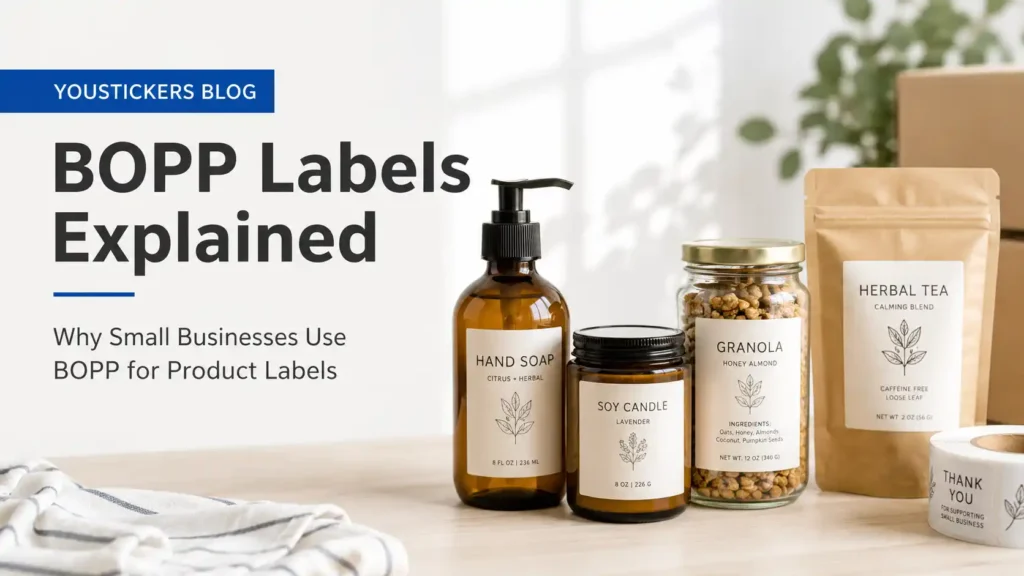
BOPP labels are one of the most practical label choices for small businesses that sell physical products. If your label needs to stay readable on a jar, bottle, pouch, candle tin, cosmetic container, or refrigerated item, BOPP is often a safer choice than standard paper.
The reason is simple: BOPP labels are made from biaxially oriented polypropylene, a plastic film used in pressure-sensitive labeling. Compared with many paper labels, film labels are generally better suited for moisture, oils, regular handling, and packaging environments where the label needs to stay smooth and legible.
What Are BOPP Labels?
BOPP stands for biaxially oriented polypropylene. “Biaxially oriented” means the polypropylene film is stretched in two directions during manufacturing, which helps create a stable, durable film for labeling and packaging use.
For a small business owner, the technical name matters less than the everyday result: BOPP labels feel smooth, look clean, and hold up well on many common product containers.
Most BOPP labels are pressure-sensitive labels. That means they have an adhesive backing and bond to the surface when pressure is applied. They are usually supplied on rolls, which makes them easier to peel, apply, store, and use in batches than individual sticker singles.
YouStickers offers custom labels in roll format for product packaging, bottles, cosmetics, homemade goods, candles, and other small-business uses. Its custom label page describes durable labels as waterproof and built for product applications where durability matters.
Why Small Businesses Use BOPP for Product Labels
Small businesses often choose BOPP because packaging gets handled more than people expect. A candle label may be picked up, turned around, packed, shipped, unpacked, displayed, and handled by customers. A sauce label may deal with condensation, kitchen oils, refrigeration, and repeated touching. A cosmetic label may come into contact with moisture, lotions, oils, or bathroom humidity.
Paper labels can be beautiful, but they are not always the most forgiving choice for those situations. BOPP is popular because it gives small businesses a more durable label without making the label feel bulky or overly industrial.
Film and BOPP labels are commonly used for product packaging because they can handle moisture, oils, curved surfaces, and regular handling better than basic paper stock. YouStickers makes this same distinction in its sticker-versus-label guidance, especially for jars, bottles, bath products, beverage containers, and refrigerated items.
How BOPP Labels Feel
BOPP labels usually feel smooth, thin, and professional. They do not have the fibrous feel of paper. They also tend to sit cleanly on bottles, jars, tubes, and containers when the label size and surface are a good match.
White BOPP gives the most predictable print result because the white base helps colors and text stay readable. Clear BOPP creates a more transparent “printed-on” look, especially on glass, clear plastic, or smooth packaging. Metallic BOPP can create a reflective or premium-looking label when the design calls for shine.
The finish also changes the final feel. A gloss finish can make colors look brighter and more polished. A matte finish can feel softer, reduce glare, and work well for minimal, natural, or higher-end packaging designs.
BOPP Labels vs Paper Labels
BOPP and paper labels both have a place in product packaging. The right choice depends on where the product will be sold, stored, handled, and used.
| Feature | BOPP labels | Paper labels |
|---|---|---|
| Feel | Smooth film | Softer paper texture |
| Moisture resistance | Better for condensation, damp handling, and refrigerated products | Better for dry indoor products |
| Oil resistance | Better for cosmetics, bath products, sauces, candles, and kitchens | More likely to stain or absorb oils |
| Best uses | Bottles, jars, cosmetics, candles, bath products, food packaging, beverages | Dry goods, gift packaging, short-term labels, rustic packaging |
| Appearance | Clean, modern, durable | Warm, textured, natural, classic |
| Batch application | Often supplied as roll labels | Can be roll or sheet format |
Choose BOPP when the label needs to work hard. Choose paper when the label’s texture, natural feel, or short-term use is more important than durability.
Best Uses for BOPP Labels
BOPP labels are especially useful for products that face moisture, oils, frequent handling, or retail display conditions.
Good uses include:
- water bottle labels
- beverage labels
- sauce and condiment labels
- jar labels
- candle labels
- soap labels
- lotion labels
- shampoo and conditioner labels
- cosmetic labels
- lip balm labels
- bath and body product labels
- supplement-style packaging labels
- freezer or refrigerated product labels, when the adhesive and finish are appropriate
- coffee bag labels
- bakery packaging labels
- farmers market product labels
- ecommerce packaging labels
BOPP is also a good fit when the label has important text that needs to remain readable, such as scent names, flavor names, ingredient panels, QR codes, barcodes, usage instructions, warnings, batch numbers, or brand information.
White, Clear, and Metallic BOPP
The most common BOPP label options are white, clear, and metallic.
White BOPP is the safest all-around choice. Use it when you want full-color artwork, strong contrast, readable text, and predictable results across different container colors.
Clear BOPP works well when you want the container or product color to show through. It is popular for glass bottles, jars, clear plastic containers, and minimalist packaging. The tradeoff is readability. Clear labels can disappear on dark, busy, or uneven backgrounds.
Metallic BOPP is useful when the label design needs shine. It can work well for candles, cosmetics, specialty foods, limited-edition products, beverages, and premium-looking packaging. Use metallic effects carefully. Too much shine can make small text harder to read.
BOPP Labels vs Vinyl Stickers
BOPP labels and vinyl stickers are related in that both are durable film-based print products, but they are usually ordered for different reasons.
Use BOPP roll labels when the label belongs on a product. Examples include jars, bottles, candles, boxes, tins, tubes, bags, and retail packaging. Roll labels are easier to use when you are applying the same design over and over.
Use vinyl stickers when the sticker is meant to be used on its own. Examples include laptop stickers, water bottle stickers, event giveaways, merch stickers, logo stickers, school stickers, artist stickers, and promotional handouts.
A simple rule: if it helps identify, explain, or package a product, it is probably a label. If someone might put it on a laptop, bottle, notebook, helmet, or toolbox, it is probably a sticker.
Practical Recommendation: Should Your Business Use BOPP Labels?
Use BOPP labels if your product will be handled often, stored cold, exposed to condensation, used near moisture, touched with oily hands, or displayed in retail packaging. BOPP is especially practical for small businesses that sell candles, sauces, drinks, skincare, bath products, cosmetics, jars, bottles, and handmade goods.
Use white BOPP for most first orders because it gives the clearest and most predictable print result. Use clear BOPP when you want the container to show through. Use metallic BOPP when shine is part of the packaging style.
For most small businesses, the best starting point is a custom roll label in a readable size with a durable film material, clean artwork, and enough contrast for the product container. YouStickers custom labels are built for roll-label packaging workflows, which makes them a practical next step when you are labeling products in batches.
Common Mistakes to Avoid
Do not choose paper labels just because they are familiar. Paper can work well for dry goods, but it may wrinkle, stain, or wear faster around moisture and oils.
Do not use clear BOPP if your design needs a white background to stay readable. Clear labels can look excellent, but the container color becomes part of the design.
Do not make text too small. Product labels often include flavor names, scent names, ingredients, warnings, QR codes, and barcodes. If the label is small, simplify the design before printing.
Do not ignore the curve of the container. A tall rectangular label may look good on screen but wrinkle or lift on a small curved jar or narrow bottle.
Do not place important text too close to the edge. Leave a safe zone so small text, borders, and logos are not crowded by the cutline.
Do not assume one label material works for every product. Refrigerated food, oily cosmetics, candles, dry boxes, and glass bottles may all need different label decisions.
Do not skip a proof review. Check spelling, size, orientation, barcode placement, ingredient text, and how the label will sit on the container before approving the order.
Simple Artwork Checklist for BOPP Labels
Before ordering BOPP labels, check these basics:
- Is the label size correct for the jar, bottle, box, bag, or tube?
- Is the text readable at the final printed size?
- Is there enough contrast between the label and container?
- Are barcodes or QR codes large enough to scan?
- Is important text away from the cut edge?
- Does the design need white BOPP, clear BOPP, or metallic BOPP?
- Will the label be applied by hand or with a labeling machine?
- Will the product face moisture, refrigeration, oils, or heavy handling?
- Is the label shape practical for the container curve?
- Has the proof been checked carefully before printing?
FAQs
Are BOPP labels waterproof?
BOPP labels are commonly used for water-resistant or waterproof label applications, depending on the exact material, adhesive, ink, laminate, and use conditions. They are a strong choice for products that may face condensation, refrigeration, bathroom humidity, or light moisture exposure.
Are BOPP labels good for food products?
Yes, BOPP labels are commonly used for food and beverage packaging, especially bottles, jars, sauces, drinks, and refrigerated items. The label artwork should still be designed for readability, ingredient information, barcode scanning, and any packaging requirements that apply to the product.
Are BOPP labels good for candles?
Yes, BOPP labels can work well for candle jars and tins because they have a clean retail look and handle regular customer handling better than many basic paper labels. For candle packaging, make sure the label fits the jar curve and that scent names, brand names, and safety information are easy to read.
What is the difference between white BOPP and clear BOPP?
White BOPP has a white film base, which helps colors and text stay bold and readable. Clear BOPP has a transparent base, which lets the container show through. White BOPP is usually safer for readability, while clear BOPP is better for a subtle no-label look.
Are BOPP labels better than paper labels?
BOPP labels are usually better for moisture, oils, handling, and many product packaging uses. Paper labels can be better when you want a textured, natural, rustic, or classic paper feel and the product will stay dry.
Should I order BOPP labels on rolls or sheets?
For product packaging, roll labels are usually the better choice because they are easier to store, peel, and apply in batches. Sheets can work for very small quantities or mixed designs, but rolls are usually more efficient for repeated product labeling.
