
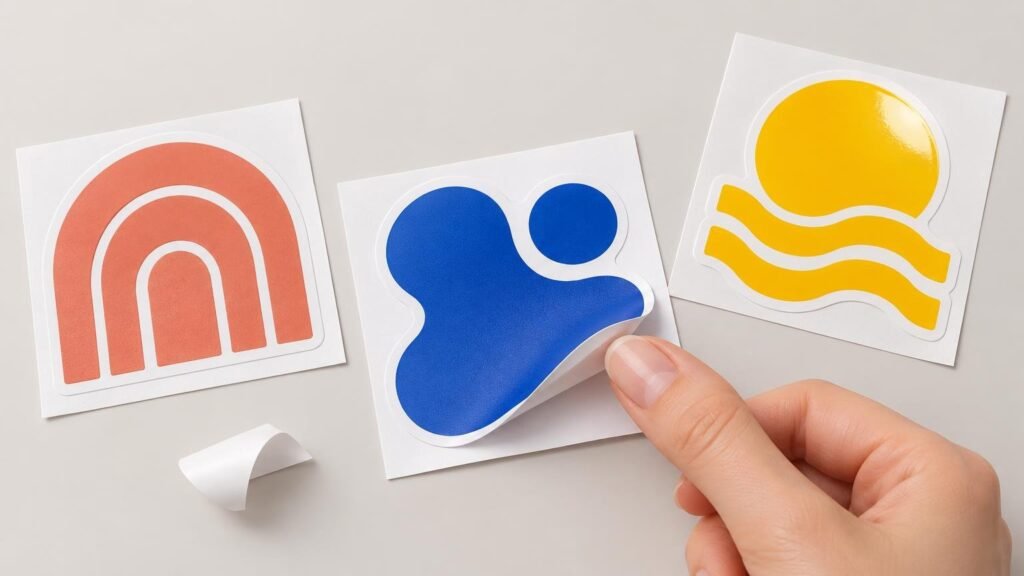
TLDR: A soft touch sticker finish is chosen primarily for its tactile effect: it is commonly described as velvety, smooth, or suede-like. It is not simply another name for ordinary matte. Choose it only when the printer explicitly offers and identifies the finish, and request a physical sample when feel, fingerprint visibility, or scuffing matters. Choose standard matte for lower glare and gloss for shine and stronger visual color impact.
The difficult part of evaluating a soft touch sticker finish is that a screen cannot show you how it feels. Product photos may also make soft-touch and standard matte surfaces look nearly identical. The meaningful differences appear after printing, when the sticker is handled, rubbed against other items, photographed, or applied to its intended surface.
That makes this a material-system decision rather than a purely visual preference. Before ordering, consider the top layer, printed material, adhesive, application surface, and real use conditions. The words “soft-touch” alone do not establish outdoor life, water resistance, fingerprint resistance, or scuff resistance.
What is a soft touch sticker finish?
Soft-touch generally describes a specialty surface engineered to have a distinct tactile character. Depending on the product, the effect may come from a film, laminate, or coating. People often describe it as velvety or suede-like, but the actual sensation varies by construction and manufacturer.
Matte, by comparison, primarily tells you that a surface reflects less direct light than a glossy one. A standard matte laminate can feel smooth without having the more pronounced tactile quality associated with a true soft-touch product. If an order page lists only “matte,” do not assume it means soft-touch.
This distinction matters for packaging seals, creator merchandise, presentation boxes, and promotional stickers meant to be handled. A tactile finish can support a restrained, high-contact presentation, but it offers little benefit when stickers will be viewed briefly, exposed to demanding conditions, or distributed as inexpensive event handouts.
Soft-touch vs. matte vs. gloss stickers
| Finish | Typical tactile and visual character | Potential concern | Good fit |
|---|---|---|---|
| Soft-touch | Low-shine appearance with a deliberately velvety or suede-like tactile effect | Handling marks and scuff behavior depend on the exact product; availability may be limited | Premium-feeling packaging, presentation pieces, and designs meant to be handled |
| Standard matte | Lower glare with a smooth, restrained appearance | May mute some visual intensity compared with a reflective gloss surface | Readable text, understated branding, photography, and glare-sensitive applications |
| Gloss | Smooth, reflective surface that can make color appear more visually impactful | Reflections can interfere with viewing or photography under direct light | Bright illustrations, colorful logos, promotional stickers, and designs intended to catch light |
YouStickers’ material guidance characterizes matte as the lower-glare choice and gloss as the shinier option for stronger visual impact. Its detailed matte versus glossy sticker guide covers that two-way decision in more depth.
If touch is not central to the project, matte or gloss will usually make the decision easier. Matte favors controlled reflections and a subdued presentation. Gloss favors shine and visual punch. A true soft-touch option is most relevant when the physical interaction is part of the design brief.
Scuffing and fingerprints are product-specific
Do not treat “soft-touch” as a guarantee that fingerprints will disappear. Skin oils, pressure marks, rubbing, and abrasion can present differently across films and coatings. Dark solid colors may also make surface variation more noticeable than a light or visually busy design. The responsible way to judge the result is with a physical sample made from the intended material system.
For a packaging project, simulate the actual workflow. Handle the sample with ordinary hands, slide it into a mailer, rub it against adjacent products, and view it under the lighting where customers will see it. This is not a standardized durability test, but it can reveal whether visible handling marks conflict with the design goal.
If scuffing would make a large black background unacceptable, ask the printer for the applicable technical specification and a representative sample. Avoid relying on a photograph of a different product. A soft-touch book cover, folding carton, and pressure-sensitive sticker may use different constructions even when their surfaces are described with similar language.
What an overlaminate does—and does not prove
An overlaminate is a film applied over printed graphics. It can contribute protection as well as the surface appearance and feel. Avery Dennison explains that its overlaminate films for printed graphics contribute to durability and color longevity, particularly in exterior graphic applications.
That general function does not mean every laminated sticker is suitable for every outdoor, wet, high-abrasion, or dishwasher application. Performance depends on the complete construction: printable material, ink system, laminate, adhesive, surface preparation, edge exposure, application surface, and environment.
Ask for specifications tied to the exact sticker or label being purchased. Useful questions include whether the stated performance applies outdoors, what exposure conditions were assumed, and whether the laminate is the same option used for your order. Finish names are aesthetic descriptions, not substitutes for those details.
How to choose the right finish
Choose true soft-touch when feel is part of the experience
Consider soft-touch for a limited-run package seal, presentation insert, or merchandise sticker that customers will hold and inspect. Confirm that the option is explicitly called soft-touch rather than inferring it from “matte.” A physical sample is more useful than a digital mockup because a proof cannot communicate tactile feel.
Choose matte when glare and readability matter
Standard matte is a practical choice for labels or stickers with restrained branding, detailed text, or surfaces likely to be photographed under direct lighting. It can create a quieter visual result without requiring a specialty tactile construction.
Choose gloss when color and reflected shine suit the design
Gloss works well for vivid illustrations, bright logos, and promotional pieces intended to attract attention. The tradeoff is reflection: small type or low-contrast details can become harder to inspect when a strong light source reflects from the surface.
When comparing quotes for custom stickers, make sure every provider is pricing the same size, material, finish, cut style, quantity, and delivery format. “Matte” from one listing and “soft-touch” from another are not automatically equivalent options.
Check current availability before designing around the effect
The documented YouStickers die-cut sticker page lists matte and gloss choices for a laminated vinyl sticker construction. That listing does not establish that soft-touch is available for that product or unavailable everywhere else, so check the live configurator or ask support about the exact product before committing the artwork to a tactile concept.
This verification should happen before approving a quote, especially if the finish is central to a client presentation or product launch. Ask for the commercial name of the finish, whether it is a coating or laminate, which sticker or label formats support it, and whether a representative sample is available.
What to inspect in the proof and sample
Treat the digital proof and physical sample as two different checkpoints. The proof can show geometry and placement. The sample can answer tactile and handling questions.
- Confirm the final dimensions, shape, and cutline.
- Check that important logos and text have comfortable clearance from the cut edge.
- Inspect large dark areas where fingerprints, pressure marks, or rub patterns could be visually distracting.
- Verify that “soft-touch” is written into the order specification rather than assumed from a matte-looking preview.
- Ask whether the sample uses the same face material, printing process, top layer, and adhesive as the planned order.
- Test the finished construction on the intended bottle, box, mailer, laptop, or other surface.
- Confirm any required water, outdoor, UV, cleaning, or abrasion performance separately from the finish name.
Frequently asked questions
Is soft-touch the same as matte?
No. Matte describes a low-shine visual surface, while soft-touch identifies a deliberate tactile effect. A soft-touch finish is often matte-looking, but an ordinary matte sticker does not necessarily have a velvety feel.
Does soft-touch resist fingerprints?
Not automatically. Fingerprint and handling-mark visibility depend on the specific surface, color, lighting, and use. Request a representative sample and handle it under realistic conditions instead of relying on the finish name.
Does laminate make a sticker suitable for outdoor use?
Not by itself. An overlaminate can contribute protection, but outdoor suitability depends on the complete printed and adhesive construction, application, and exposure conditions. Confirm the specification for the exact product.
Will a sticker adhere to a soft-touch-coated bottle or package?
That is a separate question from whether the sticker itself has a soft-touch finish. YouStickers identifies soft-touch-coated surfaces, silicone, and rubber as surfaces that can repel adhesive and recommends a small 24-hour test when adhesion is uncertain.
Can a digital proof show the soft-touch effect?
A proof can show dimensions, artwork placement, shape, border, and cutline intent, but it cannot reproduce physical texture on a screen. Use a physical sample to evaluate feel, reflections, fingerprints, and rubbing behavior.
Make the finish serve the real use case
Choose a soft touch sticker finish when tactile interaction is genuinely part of the desired experience and the printer explicitly offers a suitable construction. Choose matte when lower glare and a restrained look matter more than a specialty feel. Choose gloss when shine and visual color impact support the artwork.
Before ordering, verify the exact finish name, complete material system, application surface, performance requirements, and sample behavior. That short check is more reliable than trying to judge softness, fingerprints, or scuff resistance from an online product photo.
