
TLDR
The best sticker sizes for small business packaging depend on the package, the amount of text, and how the sticker will be used.
Small thank-you stickers usually work well around 1.5 to 2 inches. Product labels often need 2 to 4 inches or more, depending on the container.
Round stickers are great for lids, seals, and simple logo stickers. Rectangle labels are better when you need room for product names, ingredients, or instructions.
Before ordering a full batch, print the design at actual size and test it on the real packaging.
Best Sticker Sizes For Small Business Packaging
A packaging sticker can look perfect on your screen and completely wrong on the box.
That is the annoying part. The design might be clean. The logo might be sharp. The colors might fit your brand. But once the sticker goes on a jar, mailer, pouch, bottle, bag, or candle tin, the size either works or it does not.
The best sticker sizes for small business packaging are usually practical first. A sticker needs to fit the surface, stay readable, and support the product without taking over the whole package. Small stickers can feel polished and subtle. Larger labels can carry more information. The right size depends on the job.
If you are ordering packaging stickers, product labels, or thank-you stickers, custom stickers are useful for custom shapes and sizes. For product packaging that needs repeated application, custom labels are often the better fit.
Start With What The Sticker Needs To Do
Before choosing a size, decide what the sticker is for.
A logo sticker on a shipping box has a different job than an ingredient label on a candle. A thank-you sticker has a different job than a barcode label. A packaging seal has a different job than a promotional sticker that customers might put on a laptop or water bottle.
Most packaging stickers fall into a few simple categories:
- Brand logo stickers
- Thank-you stickers
- Product labels
- Packaging seals
- QR code stickers
- Warning or instruction labels
- Flavor, scent, or variant labels
- Promotional insert stickers
Each category needs a different amount of space. If the sticker only says “Thank you,” it can be small. If it includes a product name, scent, size, barcode, ingredients, and directions, it needs more room.
This is where a lot of small businesses go wrong. They choose the size based on what looks affordable or cute, then try to squeeze too much information into it. The result is usually tiny text, crowded edges, and a label that feels harder to trust.
Start with the information. Then choose the size.
Best Sizes For Thank-You Stickers
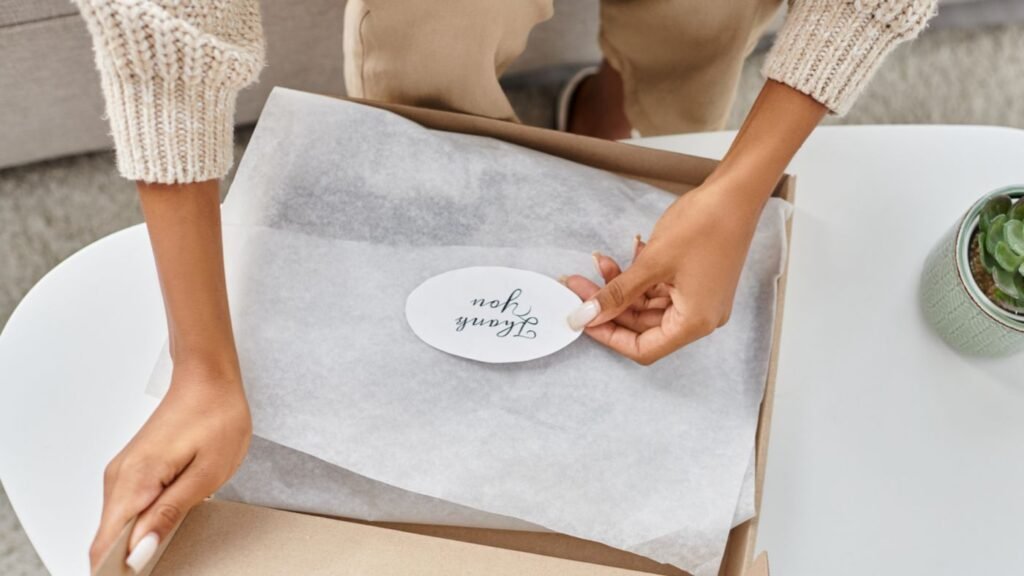
Thank-you stickers are usually small. They do not need to explain the whole brand. They just need to make the package feel more personal.
Good thank-you sticker sizes include:
- 1.5 inch round stickers for small bags, envelopes, and tissue paper
- 2 inch round stickers for boxes, mailers, and product inserts
- 2.5 inch round stickers for larger packaging or gift bags
- 2 x 2 inch square stickers for a clean, modern look
- 2 x 3 inch rectangle stickers if you want a short message and logo
For most small business orders, a 2 inch round thank-you sticker is a safe starting point. It is large enough to read but small enough to work on many package types.
A thank-you sticker can go on tissue paper, mailers, product bags, envelopes, shipping boxes, or the outside of a wrapped item. It can also work as a seal.
Keep the design simple. A short “thank you,” your logo, and maybe a small line like “for supporting our small business” is usually enough. If you add a website, social handle, discount code, and long message, the sticker may need to be larger.
For packaging inserts and customer orders, custom thank-you stickers can be a simple way to make small business packaging feel more finished without redesigning every box or bag.
Best Sizes For Logo Stickers
Logo stickers are flexible because they can be used in several ways. You can place them on shipping boxes, product bags, envelopes, retail bags, packaging sleeves, or as freebies inside orders.
Common logo sticker sizes include:
- 2 x 2 inches for small logo stickers
- 2.5 x 2.5 inches for more visual impact
- 3 x 3 inches for giveaway stickers
- 3 x 2 inches for horizontal logos
- 4 x 2 inches for wide logos or wordmarks
If the sticker is only going on packaging, smaller sizes are usually fine. If customers might use the sticker on bottles, laptops, notebooks, or cases, a 3 inch size often feels more useful.
Shape matters here. If your logo is circular, use a round sticker. If your logo is wide, use a rectangle or die cut sticker. If your logo has an irregular outline, a die cut sticker can make it feel more custom.
Do not force a wide logo into a circle unless the logo was designed for that shape. It may shrink the text too much and leave awkward empty space.
Best Sizes For Product Labels
Product labels need more room because they often carry real information. That might include the product name, flavor, scent, size, ingredients, use instructions, or business details.
Good product label sizes include:
- 2 inch round labels for lids, jars, and small candles
- 2.5 inch round labels for larger jars and tins
- 3 inch round labels for bigger containers or bold front labels
- 2 x 3 inch rectangle labels for small bottles, boxes, and pouches
- 3 x 4 inch rectangle labels for bags, jars, and food packaging
- 4 x 6 inch labels for larger bags, boxes, or detailed product information
For small jars, a 2 inch round label can work well on the lid or front. For candle jars, a 2.5 inch or 3 inch label often gives the design more breathing room. For coffee bags, snack pouches, and boxes, rectangle labels usually work better because they leave room for structured information.
A good product label should not make customers squint. If the ingredients, size, or product name are important, they need to be readable at normal viewing distance.
If you need labels for jars, bottles, candles, bags, boxes, or retail packaging, custom labels are a better choice than general-purpose giveaway stickers because labels are meant for packaging workflows.
Best Sizes For Packaging Seals
Packaging seals are usually smaller than product labels. Their job is to close tissue paper, secure a bag, seal a box, or make packaging feel more complete.
Good seal sizes include:
- 1 inch round stickers for small envelopes and tiny bags
- 1.5 inch round stickers for tissue paper and small product bags
- 2 inch round stickers for boxes, pouches, and mailers
- 2 x 1 inch rectangle stickers for folded packaging or narrow closures
A 1.5 inch round sticker is a good choice for small packaging seals. It is big enough for a logo or short message, but not so large that it overwhelms tissue paper or a small bag.
Use simple artwork for seals. A logo, icon, initials, or small phrase works better than detailed text. Seals are often bent over edges or placed on soft packaging, so tiny details may not stay easy to read.
Best Sizes For QR Code Stickers
QR code stickers need enough space to scan reliably. Tiny QR codes can become frustrating for customers, especially if the sticker is placed on curved packaging or textured material.
For QR code stickers, a good minimum is usually around 1 x 1 inch for the code itself, with extra space around it. A 1.5 x 1.5 inch or 2 x 2 inch sticker is often easier to use.
If the sticker includes text like “Scan for care instructions” or “Scan for 10% off,” give it more room. A 2 x 2 inch square sticker or 2 x 3 inch rectangle sticker is a practical choice.
Place QR code stickers somewhere flat when possible. A curved bottle or jar can make scanning harder, especially if the code bends too much around the surface.
Also leave quiet space around the QR code. Crowding the code with artwork, borders, or text can hurt usability.
Best Sizes For Bottles And Jars
Bottles and jars are harder than boxes because the surface curves. A label that is too wide can wrap awkwardly. A label that is too tall can run into the shoulder or base of the container.
For jars, these sizes often work well:
- 2 inch round labels for lids
- 2.5 inch round labels for front labels
- 3 inch round labels for larger jars
- 2 x 3 inch rectangle labels for smaller jars
- 3 x 4 inch rectangle labels for larger jars
For bottles, these sizes are common:
- 2 x 3 inch labels for small bottles
- 3 x 4 inch labels for medium bottles
- 4 x 5 inch labels for larger bottles
- Narrow vertical labels for tall bottles
Before ordering, wrap a piece of paper around the bottle or jar and mark the label area. This gives you a real sense of the available space. Do not rely only on the product photo or dimensions from a supplier listing.
The label should sit comfortably on the flattest part of the container. If it crosses too much curve, it may be harder to apply cleanly.
Best Sizes For Boxes And Mailers
Boxes and mailers give you more flexibility because the surfaces are usually flat.
For small shipping boxes, 2 to 3 inch logo stickers work well. For larger boxes, 3 to 4 inch stickers usually feel more balanced. If the sticker is meant to act as the main branded element on a plain box, larger sizes can work.
For mailers, think about where the sticker goes. A small seal near the flap can be 1.5 to 2 inches. A front-facing logo sticker can be 2.5 to 4 inches depending on the mailer size.
Poly mailers and bubble mailers often have limited visual space once the shipping label is added. Do not make the branding sticker compete with the shipping label. Put it in a clean area where it looks intentional.
Best Sizes For Bags And Pouches
Bags and pouches often need labels with enough room for product details.
For small bags, such as candy, coffee samples, jewelry bags, or small handmade goods, a 2 x 2 inch or 2 x 3 inch sticker can work well.
For medium pouches, such as coffee, tea, snacks, bath salts, or refill products, a 3 x 4 inch label is a strong starting point.
For large pouches, 4 x 6 inch labels can give you room for product name, flavor, weight, brand story, ingredients, directions, and barcode.
Kraft bags and stand-up pouches look good with simple rectangle labels. Round labels can work for front branding, but they may not provide enough room for practical details.
If the bag wrinkles or bends, avoid very tiny text. Flexible packaging moves, and the label needs to stay readable.
How To Test Sticker Size Before Ordering
Testing the size is the best way to avoid a bad order.
Print your design on regular paper at actual size. Cut it out. Place it on the real box, jar, bottle, pouch, bag, or mailer. Step back and look at it like a customer would.
Ask these questions:
- Can I read the product name quickly?
- Is the logo large enough?
- Does the sticker fit the surface?
- Does the shape make sense on the package?
- Is there enough space around the edges?
- Does the sticker look too small or too large?
- Can important details be read without squinting?
If the label includes small text, print it at the final size and read it in normal lighting. Screens make small type look cleaner than it may feel in real life.
This test takes a few minutes. It can save a full batch of labels.
Sticker Size Mistakes To Avoid
The biggest mistake is choosing a sticker that is too small for the information. A tiny sticker can look clean only if the message is simple.
Another common mistake is using one size for every package. A 2 inch logo sticker may look great on a small box but disappear on a large mailer. A 4 x 6 label may work on a coffee bag but look huge on a small jar.
Avoid these issues:
- Tiny text on small labels
- Wide labels on curved bottles
- Overly large stickers on small packaging
- QR codes that are too small
- Low contrast between text and background
- Important details too close to the edge
- One sticker size used across packages that are not the same size
A sticker should feel like it belongs on the package. It should not feel squeezed in or randomly placed.
Conclusion
The best sticker sizes for small business packaging depend on the package and the job.
A 2 inch round sticker is a strong all-purpose choice for thank-you stickers, seals, and simple logo stickers. A 3 inch sticker works well for giveaways and bolder branding. Product labels often need more room, especially when they include ingredients, scent names, size details, or directions.
The safest approach is simple: decide what the sticker needs to do, choose a shape that fits the package, and test the design at actual size before ordering.
Good packaging does not have to be complicated. It just has to feel clear, intentional, and easy to understand. The right sticker size helps with all three.
FAQs
What is the best sticker size for small business packaging?
A 2 inch round sticker is a good general size for thank-you stickers, seals, and simple logo stickers. Product labels often need larger sizes, such as 2 x 3 inches, 3 x 4 inches, or 4 x 6 inches.
What size should thank-you stickers be?
Most thank-you stickers work well at 1.5 to 2 inches. Use 1.5 inches for small bags or envelopes and 2 inches for boxes, tissue paper, mailers, and product inserts.
What size sticker is best for jars?
For jar lids, 2 inch round stickers are common. For front labels, 2.5 inch or 3 inch round labels can work well depending on the jar size.
What size label should I use for product packaging?
For small products, start with 2 x 3 inches. For medium bags, jars, or boxes, 3 x 4 inches often works well. For larger packaging with more details, 4 x 6 inches may be better.
Are round or rectangle stickers better for packaging?
Round stickers are good for logos, lids, seals, and simple thank-you designs. Rectangle stickers are better when you need space for product names, ingredients, directions, barcodes, or longer text.
Should I order stickers or labels for packaging?
Use stickers for branding, thank-you notes, seals, giveaways, and promotional packaging. Use labels when the print needs to function as part of the product packaging, especially for jars, bottles, boxes, bags, and retail goods.
