
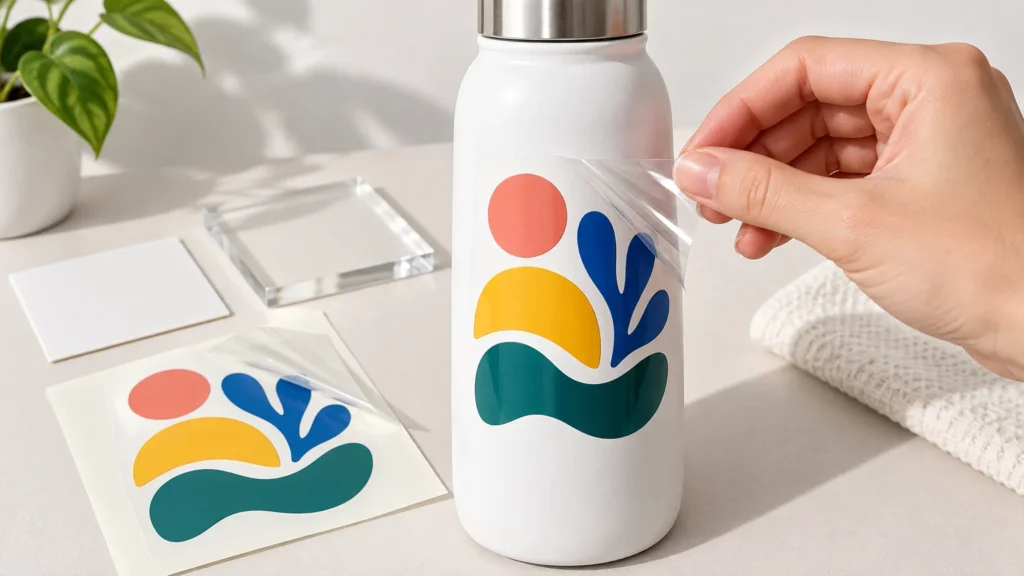
TLDR: UV DTF stickers are printed graphics transferred from film onto a hard object using pressure. Unlike an ordinary vinyl sticker, the application carrier is peeled away, leaving the printed design rather than a surrounding vinyl face film. They can be worth testing for curved or unusually shaped hard goods, but compatibility and durability depend on the transfer system and the exact finished surface. For many smooth, flat applications, a conventional vinyl sticker remains the simpler and more replaceable option.
If you are asking what are uv dtf stickers, the most useful short answer is that they are hard-surface transfers rather than conventional stickers. UV DTF stands for ultraviolet direct to film. A UV printer builds the graphic on a special film system, and the completed image is transferred to an object without the textile heat-press process associated with standard garment DTF. Mimaki describes UV DTF as printing on a special glued film that transfers to an object like a sticker.
The word “sticker” is convenient, but “UV DTF transfer” is more precise. The carrier helps position and apply the design, then comes off. That construction can produce separated letters, logos, and decorative details without a visible patch of face material connecting everything. Whether that advantage matters depends on the object, artwork, handling conditions, and ability to test the actual blank before committing to a full run.
How UV DTF transfer construction works
A typical UV DTF system uses two films commonly called A film and B film. In Mimaki’s documented workflow, the design is printed onto A film with white, color, and clear ink layers. B film is then laminated to the printed film to support transfer and application. The exact layer order, adhesive system, curing process, and application technique can vary by equipment and supplier, so those details should not be treated as universal specifications.
At application, the user exposes the transfer, aligns it on the object, applies firm and even pressure, and removes the carrier according to the supplier’s instructions. No garment heat press is normally part of this hard-goods transfer concept. Avoid borrowing temperatures, dwell times, or peeling directions from textile DTF instructions; they describe a different process.
Pressure application makes surface contact critical. Dust, oils, coatings, texture, and pronounced curves can prevent parts of a detailed graphic from making consistent contact. Thin strokes and isolated dots also have less contact area than broad shapes. A design that looks excellent on screen can therefore be difficult to apply cleanly if its smallest elements are fragile.
Start with the object, not the decoration method
UV DTF is often promoted for hard goods and objects that are awkward to run through a direct-to-object printer. Mimaki positions the method for uneven or unusually shaped objects, while also noting that some applications may require primer, surface treatment, or protective lamination. Mimaki’s UV DTF system overview That makes UV DTF a production option to qualify, not a universal answer for every hard surface.
A clean, smooth, rigid surface is the practical starting point. Glass, metal, ceramic, coated plastic, powder-coated items, and finished wood may all behave differently because the relevant coating or finish—not merely the base material—meets the adhesive. Textured, rubberized, flexible, oily, heavily curved, or low-energy plastic surfaces deserve particular caution.
InkTec Europe likewise describes UV DTF graphics as transferable to hard surfaces but cautions that they do not necessarily provide the same environmental protection as direct-to-substrate printing. Do not translate a generic “hard surface” description into promises of outdoor life, scratch resistance, dishwasher safety, waterproofing, or permanent adhesion. Those claims require evidence for the particular transfer, application process, substrate, and use conditions.
A practical qualification test
- Obtain a sample made with the intended transfer system and production settings.
- Apply it to the exact finished blank, including its real paint, coating, or surface treatment.
- Follow the supplier’s cleaning, pressure, and carrier-removal instructions.
- Check fine details, edges, curves, and recessed areas immediately after application.
- Expose the sample to realistic handling, cleaning, temperature, moisture, and storage conditions.
- Approve the production run only if the sample meets the requirements of the actual use case.
Testing a similar object is not always enough. Two drink tumblers, cases, or cosmetic containers can use different coatings even when they look alike. If the object comes from multiple factories or changes between batches, include substrate consistency in the purchasing plan.
UV DTF versus vinyl stickers, textile DTF, and direct UV printing
| Method | How the graphic reaches the item | Practical starting point | Main qualification question |
|---|---|---|---|
| UV DTF transfer | A printed graphic moves from a film system to the object through pressure application | Curved, uneven, or unusually shaped hard goods that can accept the transfer | Will the transfer apply and perform on this exact finished surface? |
| Conventional vinyl sticker | Printed face material and adhesive remain together on the object | Flat or gently curved areas, ordinary decals, labels, giveaways, and replaceable branding | Which vinyl, adhesive, finish, and laminate fit the environment? |
| Textile DTF | A garment transfer is applied to compatible fabric using a specified heat process | Apparel and other supplier-approved textiles | Can the textile and transfer tolerate the required application process? |
| Direct UV printing | UV ink is printed directly onto an object | Production setups where the object can be held and printed by suitable equipment | Can the printer fixture, ink system, pretreatment, and object geometry support the job? |
A conventional vinyl sticker is often the easier choice when the application panel is smooth and mostly flat. The sticker arrives as one supported piece, can include a printed background or border, and may be easier to remove and replace than a collection of individually transferred elements. Material, adhesive, and laminate still matter; “vinyl” alone does not establish how every product will perform. See this explanation of how vinyl stickers are constructed and used before comparing formats.
If you choose conventional custom stickers, ask for specifications tied to the particular product rather than assuming every sticker uses the same adhesive, face film, or laminate. A clear sticker may also create a no-background appearance, although transparent areas, white ink, and the edge of the clear face material can change the result.
Direct UV printing can remove the transfer step because ink is deposited onto the object itself. It may make sense for repeat production when suitable equipment, fixtures, surface treatment, and object geometry are available. UV DTF can reduce the need to place the object inside the printer, but that convenience does not prove equivalent adhesion or environmental performance.
Artwork and ordering checklist for UV DTF
Prepare the artwork around the actual application panel rather than the object’s advertised overall dimensions. Measure the usable width and height, then consider whether a curve changes how the design will align. A wide logo placed around a tapered cup can look distorted or become difficult to position even if its flat dimensions technically fit.
- Supply vector artwork when possible, especially for logos, type, and geometric shapes.
- For raster artwork, use sufficient pixel dimensions for the final physical size. YouStickers recommends 300 DPI at final size as a practical target for its print-ready sticker files, but resolution cannot repair a blurry or compressed source.
- Ask the transfer supplier about minimum printable and transferable detail. Avoid assuming every tiny line, dot, gap, or isolated accent will transfer reliably.
- Identify any required white backing and clear or gloss effects. White ink can affect opacity and how colors appear over the object.
- Confirm the final dimensions and orientation, particularly for tapered, curved, or asymmetric blanks.
- Ask whether the order arrives as individual transfers, a transfer sheet, or another production layout.
- Review any supplied proof for spelling, scale, placement, transparency, white-ink intent, and missing details.
- Order and evaluate a sample on the actual finished object before approving volume production.
A digital proof can verify the prepared design, but it cannot perfectly predict adhesion, physical texture, color over a particular substrate, or resistance to real cleaning and handling. Treat proof approval and physical sample approval as two different checkpoints. For a broader workflow, review how to move from artwork submission to proof approval without assuming that every conventional-sticker step applies unchanged to UV DTF.
Frequently asked questions
Do UV DTF transfers need a heat press?
UV DTF for hard goods is generally pressure-applied rather than heat-pressed like textile DTF. Follow the transfer supplier’s instructions instead of applying a generic temperature, dwell time, or peeling method.
Can UV DTF be used on clothing or fabric?
UV DTF is intended primarily for suitable hard surfaces. Textile DTF is a separate heat-transfer process designed around compatible fabrics. Do not substitute one for the other unless the supplier explicitly approves the material and process.
Can a UV DTF transfer be repositioned?
Do not count on repositioning. Once adhesive elements contact the surface, lifting and realigning them may distort the design or reduce adhesion. Careful dry positioning before contact is important, especially on curved objects.
Are UV DTF stickers permanent or dishwasher-safe?
Those are product- and application-specific claims. Request written guidance for the exact transfer system and substrate, then run realistic tests. A broad UV DTF label does not establish permanence, dishwasher safety, outdoor life, food-contact suitability, or scratch resistance.
Should I sample before placing a bulk order?
Yes, particularly when the item is coated, textured, flexible, curved, frequently cleaned, or handled heavily. Test the production transfer on the same finished blank and under the conditions it will actually encounter.
Choose based on the finished object
UV DTF transfers are useful to consider when a hard object is difficult to print directly and the design benefits from a transferred, no-background appearance. Their success still depends on the exact surface, artwork detail, application technique, and use environment. Start by qualifying the object and testing a production sample. If the job is a straightforward flat decal, package sticker, or replaceable piece of branding, conventional vinyl may offer a simpler path with fewer application variables.
