
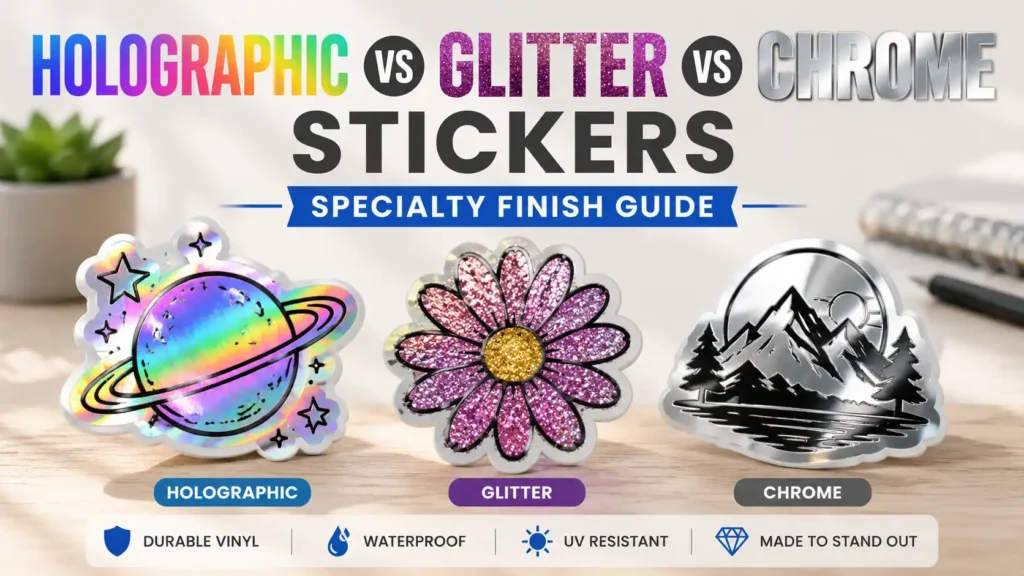
TLDR
- Choose holographic stickers when you want a rainbow, color-shifting effect that changes with the light.
- Choose glitter stickers when you want a playful sparkle effect for rewards, events, beauty packaging, kids’ products, planners, or fun merch.
- Choose chrome stickers when you want a mirror-metallic look that feels bold, polished, and high contrast.
- Holographic and chrome finishes usually work best with simple artwork, strong outlines, and intentional use of white ink.
- Avoid specialty finishes for tiny text, detailed QR codes, barcodes, or designs where exact color matching matters most.
Holographic vs Glitter vs Chrome Stickers: The Simple Difference
Choosing between holographic vs glitter vs chrome stickers is really about choosing how much shine you want and what kind of shine fits the design.
A holographic sticker has a rainbow effect. As the sticker moves, the surface can shift through different colors. That makes holographic stickers a strong choice for art, merch, limited-edition designs, character stickers, bold logos, and anything that should feel more eye-catching than standard white vinyl. YouStickers describes its holographic stickers as custom stickers printed on holographic vinyl with a rainbow effect that can be cut to the shape of your design.
A glitter sticker has a sparkle effect. Instead of looking like a smooth rainbow film, glitter usually reads as many small reflective points. That can feel more playful, cute, celebratory, or decorative. Glitter is often a good fit for reward stickers, planner stickers, party stickers, beauty brands, kids’ products, and designs that are supposed to feel fun.
A chrome sticker has a mirror-metallic look. It is usually silver, reflective, and more polished than glitter. Chrome is a good choice for logos, badges, tech designs, automotive-style graphics, premium seals, and limited-edition merch. YouStickers describes its chrome stickers as using a metalized chrome-effect film with a mirror finish, with optional white ink control to decide which parts stay reflective and which parts print more solid.
What Makes Specialty Finish Stickers Different?
Most standard vinyl stickers are printed on white vinyl. That gives the artwork a clean, predictable base. Colors usually appear more controlled because the ink is sitting over a white background.
Specialty finishes are different because the material underneath the ink is part of the design. The shine is not just decoration added afterward. It affects how the artwork looks.
That means a specialty sticker can look great when the design is prepared for the material, but it can also surprise you if the artwork was designed for plain white vinyl.
The biggest thing to understand is this: the finish shows through wherever the print allows it to show through. If a design is printed heavily with full-color ink, the specialty effect may be more subtle. If the design has open areas, white ink planning, bold outlines, or intentional negative space, the holographic, glitter, or chrome material can become part of the artwork.
For general-purpose stickers where clean color matters more than shine, standard custom vinyl stickers are usually the safer choice. YouStickers lists vinyl stickers as a durable everyday option for merch, packaging, events, branding, laptops, bottles, and common applications.
What Are Holographic Stickers?
Holographic stickers are printed on a shiny material that creates a rainbow-like effect when light hits it. In plain English, they look like they shift color as the angle changes.
The reason this works is related to how certain films interact with light. Edmund Optics describes holographic diffraction grating film as a material that breaks white light into the color spectrum, which helps explain why holographic surfaces can create that rainbow look.
Holographic stickers are best when the design can benefit from movement and color shift. They are especially strong for:
- artist stickers
- anime, gaming, and character art
- celestial designs
- fantasy designs
- event merch
- limited-edition drops
- bold logo stickers
- festival or concert stickers
- product inserts
- collectible sticker packs
The main advantage is visual energy. Holographic material catches attention quickly. A simple moon, star, cat, logo, mountain, skull, or mascot can feel more collectible with a holo finish.
The tradeoff is color predictability. Because the background is changing in the light, colors may not look as flat or controlled as they would on white vinyl. Very soft colors can sometimes lose contrast, and tiny details can compete with the shine.
What Are Glitter Stickers?
Glitter stickers use a sparkle effect rather than a smooth mirror or rainbow effect. The surface may look like many tiny reflective points, giving the sticker a brighter, more decorative feel.
Wikipedia describes glitter as small, flat, reflective particles that come in different shapes, sizes, and colors. That basic idea is useful for understanding why glitter reads differently from holographic film: glitter looks like sparkle points, while holographic material usually looks more like a shifting rainbow surface.
Glitter stickers are best for designs that are supposed to feel fun, energetic, cute, or celebratory. They work well for:
- reward stickers
- planner stickers
- birthday stickers
- school and teacher stickers
- beauty and salon stickers
- kids’ product packaging
- party favors
- holiday stickers
- dance, cheer, or team stickers
- playful artist merch
The main advantage is personality. Glitter can make a design feel more cheerful and attention-grabbing without needing a complicated layout.
The tradeoff is readability. Glitter can compete with small type, thin lines, subtle shadows, and fine details. If the sticker includes important information, tiny text, a QR code, or a barcode, glitter may not be the best finish.
Glitter is usually strongest when the design is simple: bold shapes, larger lettering, clear outlines, and areas where sparkle can show without making the sticker hard to read.
What Are Chrome Stickers?
Chrome stickers have a mirror-metallic finish. Instead of a rainbow shift or sparkle-point effect, chrome usually feels sleek, reflective, and metallic.
This makes chrome a strong choice when the sticker should look bold, modern, technical, or premium. Chrome is often a good fit for:
- logo stickers
- badges and seals
- automotive-style graphics
- tech brands
- tools and equipment
- limited-edition merch
- product packaging accents
- black-and-silver designs
- industrial or mechanical artwork
- clean typography
Chrome is especially effective with black ink, dark outlines, and simple shapes. A black logo over chrome can create a high-contrast sticker that reads quickly. A badge shape with chrome highlights can feel more polished than a standard white vinyl sticker.
Avery Dennison’s graphics catalog includes metallic and chrome-style films for visual applications, which shows how common metallic film effects are in signage, vehicle graphics, and decorative graphics work. YouStickers’ chrome product page also explains that chrome is a metalized film rather than just “silver,” and that white underprint can be used to make some parts of the artwork more opaque while other areas stay reflective.
The tradeoff is reflection. Chrome can be harder to photograph, can show glare, and can make some colors look different than expected. If exact brand color matching is the top priority, a white vinyl sticker may be more predictable.
Quick Comparison: Holographic vs Glitter vs Chrome Stickers
| Finish | Visual Effect | Best For | Main Watchout |
|---|---|---|---|
| Holographic | Rainbow, iridescent, color-shifting shine | Art, merch, promos, limited editions, bold logos | Colors may shift depending on light |
| Glitter | Sparkly, playful reflective points | Rewards, planners, parties, beauty, kids’ products | Can reduce readability on small details |
| Chrome | Mirror-metallic, polished silver shine | Logos, badges, tech, automotive, premium seals | Glare and reflection can affect color and photos |
Best Finish by Design Style
Best for Colorful Art
Holographic is usually the best specialty finish for colorful art, especially if the artwork includes stars, fantasy themes, animals, characters, gaming designs, moons, clouds, water, magic effects, or bold shapes.
The rainbow effect can add motion and depth without changing the core artwork too much. Just make sure the design still has enough contrast when the background gets bright.
Best for Cute or Playful Designs
Glitter is usually the best choice for playful designs. It fits stickers that are meant to feel happy, decorative, youthful, celebratory, or reward-based.
Use glitter for stickers that say “great job,” “birthday girl,” “dance team,” “shine bright,” “book club,” “party crew,” or anything that benefits from sparkle.
Best for Premium or Bold Branding
Chrome is usually the best choice for premium-looking logos, badges, seals, and bold brand marks.
Chrome works especially well with black, navy, dark green, red, and simple one- or two-color artwork. It is less ideal for soft watercolor designs, delicate illustrations, or complex full-color art where the metallic finish might overpower the details.
Best Finish by Use Case
Artist Merch
Holographic is often the safest specialty finish for artist merch because it feels collectible without being too narrow. Chrome can work for bold logo-style art, and glitter can work for cute or decorative collections.
Product Packaging
Chrome can work well for premium seals, limited-edition stickers, and metallic packaging accents. Holographic can work for beauty, gaming, lifestyle, or novelty products. Glitter can work for kids’ products, cosmetics, party items, and seasonal packaging.
For high-volume product labeling, consider whether a roll label format makes more sense than individual stickers. YouStickers’ custom labels are designed for packaging workflows like jars, bottles, boxes, and retail goods.
Events and Giveaways
Holographic stickers are great for events because they feel special without needing a complicated design. Glitter works well for birthdays, school events, cheer, dance, holidays, and celebrations. Chrome works well for VIP badges, car shows, tech events, product launches, and premium giveaways.
Laptops and Water Bottles
All three finishes can work visually, but the design should be easy to recognize from a few feet away. For laptops and water bottles, avoid tiny text and make sure the sticker shape is clean. YouStickers’ chrome page specifically mentions laptops, phone cases, and water bottles as common uses for chrome stickers.
Business Logo Stickers
For most business logos, choose based on brand personality:
- Holographic for creative, playful, energetic, or youth-focused brands.
- Glitter for beauty, events, kids, gifts, boutiques, and celebration-focused brands.
- Chrome for automotive, tech, tools, fitness, premium goods, and bold logo marks.
If the logo has strict brand colors, standard white vinyl may still be better.
Design Tips for Specialty Finish Stickers
Specialty finishes work best when the artwork is designed around the material.
Use these rules before ordering:
- Use bold shapes and clear outlines.
- Avoid tiny text over shiny areas.
- Keep important information on solid, high-contrast areas.
- Use white ink or white backing strategically when available.
- Let the specialty finish show through in selected areas.
- Avoid covering the entire sticker with heavy full-color printing if you want the finish to be obvious.
- Check the proof carefully before approval.
- Ask whether the finish will affect color, contrast, or readability.
White ink is especially important. On chrome and holographic materials, white ink can block the reflective effect and help printed colors look more solid. Without white ink, some areas may look more metallic, translucent, or color-shifted than expected.
Common Mistakes to Avoid
Choosing Shine Before Thinking About Readability
A shiny sticker is only useful if people can still understand the design. If the sticker has small type, a QR code, ingredients, instructions, or a barcode, use a cleaner material or keep the important information on a solid area.
Expecting Exact Brand Colors
Specialty finishes change how color is perceived. Holographic material shifts with light. Chrome reflects its surroundings. Glitter competes with fine detail. If exact color matching matters, white vinyl is usually more predictable.
Using Too Much Detail
Fine line art, soft shadows, small patterns, and tiny text can get lost on specialty finishes. The more reflective the material, the more important contrast becomes.
Forgetting About White Ink
White ink can control where the specialty effect appears. Without it, the finish may show through more than expected. With it, selected areas can stay more opaque and readable.
Picking the Wrong Finish for the Brand
Holographic, glitter, and chrome each send a different message. Holographic feels energetic and collectible. Glitter feels playful and decorative. Chrome feels bold and polished. The right finish should match the brand, not just look shiny.
Practical Recommendation
Choose holographic stickers if you want the most versatile specialty finish for art, merch, promos, and designs that benefit from a rainbow effect.
Choose glitter stickers if the design should feel playful, cute, celebratory, or reward-based.
Choose chrome stickers if you want a bold mirror-metallic finish for logos, badges, tech designs, automotive-style artwork, premium seals, or limited-edition stickers.
For first-time specialty sticker orders, holographic is usually the easiest place to start because it works with many art styles. For cleaner branding, chrome can look more polished. For fun and decorative designs, glitter is the better personality match.
FAQs
Are holographic stickers the same as glitter stickers?
No. Holographic stickers usually have a smooth rainbow effect that changes with the light. Glitter stickers usually have a sparkle effect made from many small reflective points or a glitter-look surface.
Are chrome stickers just silver stickers?
No. Chrome stickers are more reflective than normal silver printing. A chrome sticker uses a mirror-metallic effect, so it can reflect light and surrounding colors more strongly than a flat silver ink.
Which specialty finish is easiest to read?
Chrome with strong dark artwork can be very readable, but standard white vinyl is usually the easiest if readability is the top priority. Among specialty finishes, the best readability comes from using bold contrast, simple shapes, and white ink where needed.
Which finish is best for small text?
None of these finishes are ideal for very small text. If the sticker needs ingredients, instructions, legal copy, QR codes, or fine detail, use a simpler material or keep the important information on a solid printed area.
Which finish is best for artist stickers?
Holographic is usually the best starting point for artist stickers because it adds a collectible rainbow effect without feeling too formal. Glitter is better for cute or playful collections. Chrome is better for bold graphic designs, badges, and logos.
Should I choose specialty stickers or regular vinyl stickers?
Choose regular vinyl stickers when you want the cleanest color, easiest readability, and most flexible everyday option. Choose specialty stickers when the finish itself is part of the design and you want extra visual impact.
