
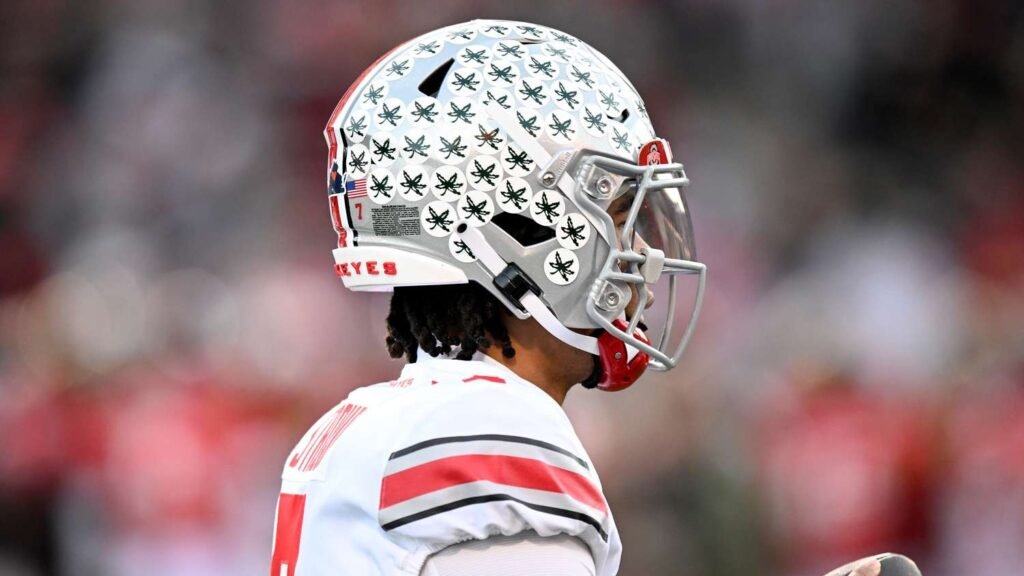
If you watched Ohio State in the College Football Playoff quarterfinal on Dec. 31 and thought, “Why are their helmets covered in little leaves?” — you’re not alone. Those decals aren’t random. They’re earned, they’re tracked, and they’re one of the most recognizable “reward systems” in all of football.
What are football helmet stickers?
Football helmet stickers (also called reward decals, pride stickers, or award stickers) are small decals teams place on helmets to recognize performance and reinforce team standards.
They’re used for things like:
- Big plays (sacks, picks, forced fumbles, touchdowns)
- Assignment execution (clean film grades, great blocks, perfect technique)
- Team outcomes (wins, rivalry wins, shutouts, low-penalty games)
- Off-field standards (academics, leadership, weight room goals, attendance)
The point isn’t “helmet decoration.” The point is visible recognition that turns effort into something you can’t ignore.
Why do teams use helmet stickers?
Helmet stickers work because they hit a few powerful levers at the same time:
They make effort visible
Football is full of unglamorous wins — a perfect kick-out block, a clean stunt, a DB who forces an incompletion by being in the right place. Stickers give coaches a way to reward those moments so they don’t disappear in the noise.
They create a culture of “earned, not given”
A blank helmet at the start of the season turns into a story by the end. Players care because the decals represent proof — to teammates, to coaches, to opponents.
They motivate without extra speeches
When players can see who’s stacking stickers, you get instant, quiet peer pressure toward the behaviors the staff values.
Ohio State helmet stickers: what are the leaf decals?
Ohio State’s stickers are the famous Buckeye Leaf decals — small white circles with a green buckeye leaf. It’s one of the most iconic traditions in college football, and it’s been part of the Buckeyes’ look since the late 1960s.
The tradition is commonly credited to the era of legendary coach Woody Hayes, with longtime athletic trainer Ernie Biggs playing a key role in introducing the idea. Over time, the decals evolved (including shrinking in size), but the meaning stayed the same: recognition for contributing to winning football.
What’s the purpose of the stickers on Ohio State helmets?
In plain English:
They’re a scoreboard for contribution.
A helmet full of buckeye leaves signals, “this player made plays, executed, and helped the team win.” That’s why casual viewers notice them — it’s visual, it’s immediate, and it tells a story even if you don’t know a single player’s name.
Ohio State’s system has changed depending on the coaching era, but the core idea remains: players can earn stickers for team results, unit goals, and individual performance.
How do players earn Buckeye Leaf stickers?
There’s no universal rulebook across all of football — even at Ohio State the criteria has varied by staff — but the common buckets include:
- Wins (team-wide awards)
- Big plays (impact moments that change possessions or points)
- Unit benchmarks (defense forcing repeated three-and-outs, special teams plays, etc.)
- Film grades (meeting position-specific standards)
And yes: equipment staffs apply them with a lot of care. Ohio State’s traditional placement builds outward near the stripe, and managers avoid covering vents and key flex points.
A fun detail that shows how “designed” the tradition is: modern Buckeye Leaf decals are roughly around the 1.25″ range, and there’s only so much real estate per helmet side — which is why the best seasons end with helmets that look like a trophy case.
Helmet stickers aren’t just an Ohio State thing
Ohio State may be the poster child, but plenty of programs use sticker reward systems.
Some well-known examples that get mentioned often:
- Michigan (decals tied to accomplishments and wins, with the program’s approach evolving in recent years)
- Florida State (tomahawk-themed decals have been part of their tradition)
- Clemson (paw-themed decals show up in the helmet-sticker conversation)
- Georgia and others have been referenced historically for unique sticker styles (dog bones, etc.)
The point isn’t which decal is “best.” The point is that sticker systems remain popular because they’re a simple, highly visible way to reinforce standards.
How to create a helmet sticker program for your team
This is where most teams go wrong: they jump straight to design before deciding what the sticker means.
Here’s what actually makes a sticker program feel “legit”:
1) Decide what you’re rewarding
Pick 5–10 clear categories. If everything earns a sticker, stickers stop mattering.
Common categories:
- “Game impact” (takeaways, sacks, TDs, special teams impact)
- “Execution” (assignment-correct, perfect technique, key blocks)
- “Discipline” (no penalties, smart situational football)
- “Team goals” (wins, rivalry wins, playoff/regionals, shutouts)
- “Off-field” (academics, leadership, attendance)
2) Decide who awards them (and when)
Players care more when sticker awards are consistent. Pick a rhythm:
- After film review
- Weekly team meeting
- Monday/Tuesday install
- Coach position meeting
3) Decide if you want one sticker style or multiple
Ohio State uses one iconic decal. Michigan has used decals with different meanings. Either approach works — just don’t create a chaotic system nobody can decode.
How to make helmet stickers that look legit (and last)
If you want decals that look like real football award stickers — not “craft day with a Cricut” — the material and finishing choices matter.
Use durable, outdoor-grade vinyl
Helmet decals take abuse: friction from bags, helmet racks, rain, heat, sweat, fingers picking at edges. You want:
- Quality vinyl with a strong adhesive
- A laminate layer (gloss or matte) for scratch and water resistance
Keep them small (small decals survive curves)
Curved surfaces are brutal on big stickers. Smaller decals:
- conform better
- peel less
- look more “authentic” (because most real reward decals are compact)
Choose the right cut style
For award stickers, the classic look is:
- a die-cut shape (like a leaf) inside
- or a circle with a design inside (like Ohio State)
Sticker sheets are great if you’re doing high volume — coaches love being able to peel quickly and keep spares.
Don’t cover vents, flex points, or safety labels
Equipment managers avoid covering vents and key flex areas for a reason: you don’t want decals interfering with helmet function or airflow.
Also: helmets have required warning/certification labels that must remain visible. Your sticker placement should work around those labels — not over them.
Make removal part of your plan
Some teams keep helmets year-to-year; others reset. If you want clean removals at season end, talk through:
- removable vs permanent adhesives
- how you’ll remove residue safely
- whether you’ll replace helmets or recondition them
Quick “legit design” rules (so yours don’t look homemade)
- High contrast (readable from the stands)
- Simple shape (leaf, star, badge, paw, bolt)
- Limited colors (1–2 colors looks more professional)
- Consistent size (don’t mix random dimensions)
- One strong symbol (don’t cram text into tiny decals)
And if you’re doing this for a school or public program: use original artwork or licensed marks. Don’t copy another team’s logo.
FAQ
Do helmet stickers affect safety?
Applied correctly, small decals are common at every level. The key is placement: avoid vents/flex areas and don’t cover safety/certification labels.
Why do some teams not use helmet stickers?
Some programs prefer a “team-first, no individual rewards” approach. Others avoid them for aesthetic uniform reasons. And some leagues/teams keep things simple for equipment consistency.
How many stickers can fit on a helmet?
It depends on size and helmet model, but there’s a practical limit per side — which is part of what makes a “full helmet” look impressive.
What’s the best finish: gloss or matte?
Gloss tends to pop under lights. Matte can look cleaner and reduce glare. Either can work if the laminate is durable.
Can you print helmet stickers in bulk?
Yes — and if you’re running a full program (youth league, high school, college club), bulk sheets are usually the easiest way to manage weekly awards.
References
College Football Playoff quarterfinal matchup details (Miami vs. Ohio State, Dec. 31, 2025). College Football Playoff
Game recap/result context (Miami vs. Ohio State at the Cotton Bowl CFP quarterfinal). ESPN.com
Ohio State “Football Traditions” page (Buckeye Leaves origin and tradition start). Ohio State

