
The difference between custom stickers for personal use vs selling online is not necessarily the artwork. It is the job that the finished sticker must perform. A personal order only needs to satisfy your project, whether that means decorating a laptop, making gifts, adding seals to party favors, or creating a few designs for yourself.
Once you sell that same design, it becomes a repeatable customer product. Its size, cut, finish, packaging, listing photos, and condition on arrival must match what the buyer expects. That calls for more deliberate proofing and inventory planning, but it does not require starting with a large order. A controlled initial run is usually the more informative approach.
Personal stickers and stickers for sale at a glance
| Decision | Personal use | Selling online |
|---|---|---|
| Primary goal | Fit one project or preference | Deliver a consistent product to multiple customers |
| Format | Whichever format suits your intended surface or activity | A format that is easy to list, store, pack, and fulfill |
| Quantity planning | Order what the immediate project needs | Test demand before committing to deeper inventory |
| Artwork rights | Permission still matters when using someone else’s work | Commercial reproduction and sale must be permitted |
| Proofing priority | Appearance, size, shape, and intended surface | Repeatability, listing accuracy, readable details, and consistent variants |
| Packaging | Often minimal | Must protect the item and clearly present what the customer receives |
| Fulfillment | You receive and use the order | You must also store, pack, ship, and support customer orders |
Choose a sticker format that fits the job
Individual die-cut stickers are a straightforward choice for a logo, character, slogan, or illustration sold or handed out as one item. Each sticker is cut to its outer shape and supplied on a backing. This format is easy to understand in an online listing, but sellers should state the finished dimensions rather than relying on a photo to communicate scale.
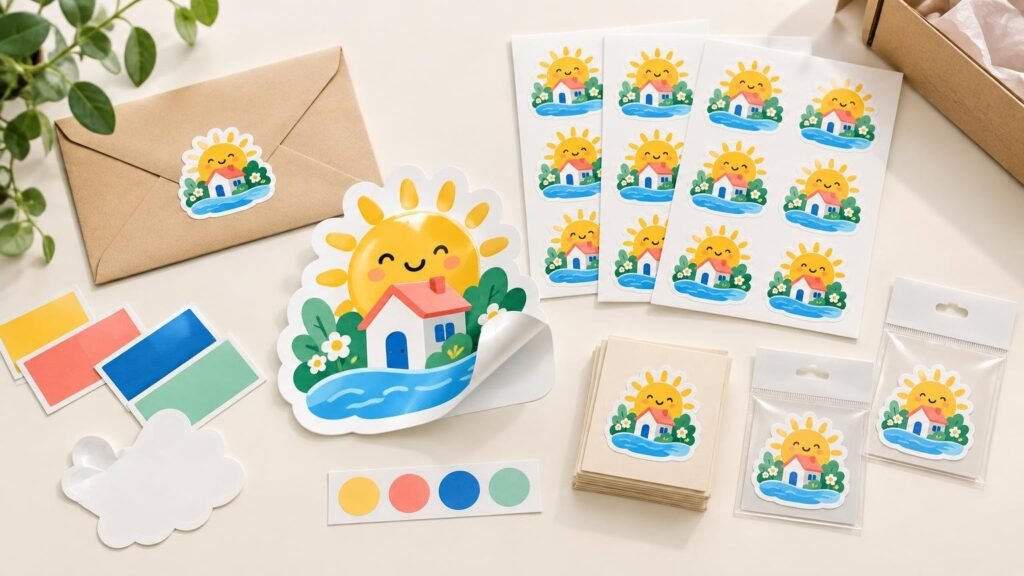
Sticker sheets keep several kiss-cut designs together on one larger liner. They work well for themed collections, planner-style designs, mailers, and sets containing multiple small illustrations. Sticker packs contain separate pieces grouped as a set and can support a more retail-oriented presentation. YouStickers describes its packs as including assembly and packaging components, with header or backer card options available for presentations that need them. For a closer format comparison, see sticker sheets vs sticker packs vs singles.
A label is different from creator merchandise even when the printing process looks similar. Labels are usually applied repeatedly to jars, pouches, boxes, bottles, or other packaging. If the design identifies a product or seals packaging, application speed and container fit may matter more than whether each piece can be sold individually.
- Choose a single die-cut sticker for a standalone design, giveaway, or simple merchandise item.
- Choose a sticker sheet when several small designs belong together and should remain on one backing.
- Choose a pack when separate stickers need to be sold as one coordinated set.
- Choose a packaging label when the piece will be repeatedly applied to products, containers, or mailers.
Custom stickers for personal use can follow the project
For personal stickers, begin with the surface and viewing distance. A small sticker for a phone case needs simpler artwork than a larger sticker for a storage bin. Fine lettering, narrow gaps, and delicate outer shapes may look excellent on screen but become hard to read or handle when reduced to the final physical size.
Think about where the sticker will go and how permanent you want the placement to feel. A notebook, gift box, event favor, laptop, and outdoor item expose a sticker to different handling and conditions. Confirm that the specific material and finish offered for your chosen product fit that use rather than assuming every sticker format has the same construction or durability.
Personal use also gives you freedom to prioritize preference over standardization. You can mix sizes, make an unusual shape, or create a sheet containing unrelated designs. The essential production checks are still final dimensions, readable details, cut shape, border consistency, and whether transparent areas appear as intended.
Selling online requires a repeatable product system
For an online shop, decide what the customer receives before deciding how many units to print. Define the finished size, design or variant name, format, finish, and quantity per package. A listing titled “sticker set” should make it clear whether the buyer receives one sheet, several loose stickers, or multiple copies of one design.
Keep the first production run tied to a realistic test. Consider your audience size, launch plan, storage space, packaging capacity, and the number of variants. Ten designs ordered deeply can create much more inventory exposure than one or two designs tested modestly. The useful question is not which quantity guarantees profit—none does—but how much inventory you can sell or repurpose without creating operational strain. Planning an initial sticker quantity can help you work through those variables.
When comparing suppliers or preparing a test order, inspect the live size, quantity, material, finish, proofing, and shipping details for the exact product. You can also browse custom sticker printing options when evaluating how your design could be produced. Avoid treating a category-wide message as a guarantee for every configuration because minimums and production details can vary by format.
Build consistent variants
If you offer multiple sizes or finishes, give each version a clear stock-keeping name. Record the approved dimensions and retain the final artwork associated with each variant. This reduces the chance of reordering a two-inch design when the listing promises three inches, or sending a finish different from the one shown.
Photograph the actual production version when practical. Mockups are useful for showing scale or placement, but they should not imply contents, colors, packaging, or specialty effects that the delivered item does not have. Screen color is also not a perfect prediction of printed color, especially when clear, holographic, chrome, or other specialty bases influence contrast.
Clear artwork rights before offering a design for sale
Selling a printed design requires more than having access to the image file. The U.S. Copyright Office explains that copyright generally begins when original visual artwork is fixed in a tangible form. Copyright owners hold rights that include making, selling, distributing, adapting, and publicly displaying copies. Using another owner’s protected work in those ways generally requires permission. The Copyright Office’s guidance for visual artists provides an accessible overview.
Use artwork you created or confirm that the applicable agreement or license permits physical reproduction and commercial sale. “Royalty-free” does not automatically mean unrestricted, and permission to post an image online may not include permission to sell it as merchandise.
Fan art, company logos, characters, stock assets, clip art, commissioned illustrations, photographs, and AI-generated imagery can raise different copyright, trademark, contract, or publicity-right questions. No production file or proof can establish whether you have the required rights. Review the actual license or agreement, and seek qualified advice when ownership or commercial permission is unclear.
Treat the digital proof as a production checkpoint
YouStickers lists PNG, JPG, PDF, AI, and SVG among its accepted artwork formats and states that it can create the cutline before sending an online proof. Vector files such as AI, SVG, or a suitable PDF are useful for scalable logos and text. For raster artwork, target 300 DPI at the final physical size. A file can have a high pixel count yet still become soft if enlarged substantially.
PNG is generally the more useful raster format when transparency matters because JPG does not preserve transparent areas. Convert text to outlines or embed fonts where appropriate so a missing typeface does not change the design. If you want a white border, make sure its thickness appears intentional and reasonably consistent around the cutline.
For sticker sheets, YouStickers recommends approximately 1/8 inch of bleed beyond cutlines and about 1/8 inch of interior clearance for text and logos. Bleed extends background artwork past the cut so minor cutting variation does not expose an unwanted edge. Interior clearance keeps important content away from that same cut.
- Confirm the stated final width and height.
- Inspect the outer cutline and every kiss-cut shape on a sheet.
- Check that borders look consistent around the artwork.
- Keep important text, logos, and faces comfortably inside the cut.
- Verify which areas should be transparent and which should print with white ink on specialty materials.
- Read small text at approximately the size it will appear in print.
- Confirm the orientation, number of designs, and arrangement.
- Make sure the proof represents the intended product variant and finish.
Do not approve a proof merely because the artwork itself looks familiar. The proof is your chance to catch production interpretation issues. This artwork-to-proof ordering guide explains the checkpoint in more detail.
Package and describe the product accurately
Packaging should protect the stickers without adding complexity that the product does not need. A single sticker may only require a protective sleeve or rigid mailer setup, depending on its size and how the order is shipped. A sheet should be kept flat. A coordinated pack may benefit from a clear sleeve and a backer or header card that identifies the set.
A header card makes the most sense when the pack will hang in a retail display, needs branding above the contents, or benefits from a closure. A backer card can add structure and provide room for a collection name or basic information. Neither is automatically necessary for a low-cost mail-order set.
- State the exact finished dimensions and whether they refer to each sticker or the full sheet.
- Identify whether the buyer receives a single, sheet, or pack.
- List how many pieces or designs are included.
- Name the material and finish using the terms for the actual ordered product.
- Show the backing, sheet, or pack when it helps explain delivery format.
- Describe specialty effects without implying that transparent or reflective areas look identical under every light.
- Use shipping packaging that helps prevent bending, moisture exposure, or loose pieces.
Plan production and fulfillment before announcing a launch
A printer’s production estimate is not the same as the date your customer will receive an order. Your launch plan may need time for proof revisions, production, inbound transit, inspection, packing, and outbound delivery. Recheck the current product and shipping pages before publishing a preorder deadline or promised ship date.
Also review the applicable problem-reporting and return terms. YouStickers’ current policy says made-to-order products generally are not returnable for a change of mind and asks customers to report production or shipping problems within 14 days of delivery with photos and order information. Policies can change, so verify the current terms for your order rather than copying them into a permanent shop workflow.
Remember the business obligations outside printing
Selling online may involve registration, tax, permit, recordkeeping, platform, and consumer-protection obligations. The details depend on your location, business activities, sales channels, and where customers are located. The U.S. Small Business Administration’s business resources note that state and local requirements vary and that online sellers’ tax responsibilities can depend on their presence or nexus in a state. Use the appropriate state and local agencies or qualified professionals for guidance specific to your situation.
Start with the smallest production plan that answers your question
For personal use, optimize the sticker around the object, event, gift, or design you want to enjoy. For online sales, define a consistent product, clear the artwork rights, approve the physical production details carefully, and build enough packaging and fulfillment time into the launch.
Your first run does not need to predict an entire business. It only needs to answer the next useful question: Does the size work? Does the set make sense? Does the packaging protect it? Do customers understand the listing? Start with a controlled format and quantity, inspect the finished order, and use what you learn before expanding the range.
