
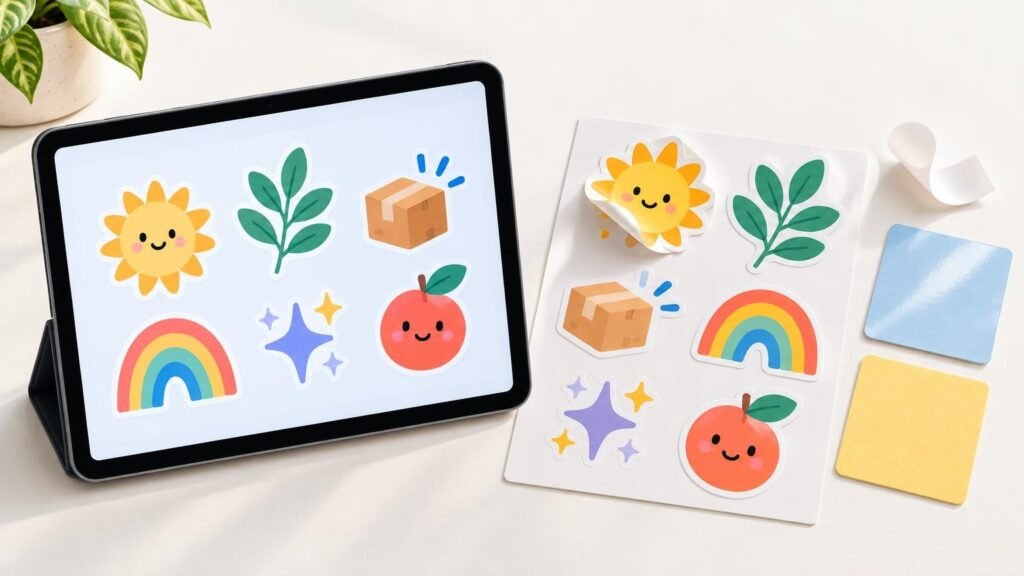
The practical difference between digital and physical stickers is not simply download versus print. They are different products with different customers, production risks, fulfillment work, and definitions of quality. Digital stickers are software-compatible graphics purchased for planners, notes, messaging, or creative layouts. Physical stickers are printed, cut, packed, shipped, peeled, and applied to real surfaces.
Digital stickers usually provide the easier and less expensive entry point because one finished file can be delivered repeatedly without replenishing inventory. Physical stickers require manufacturing and fulfillment, but they can serve more tangible purposes: merchandise, packaging, event handouts, product labels, laptop decals, water-bottle stickers, and branded inserts. Neither model is automatically more profitable. The better choice depends on your artwork, audience, selling platform, available time, and willingness to manage physical operations.
The business models at a glance
| Decision factor | Digital stickers | Physical stickers |
|---|---|---|
| Product | Downloadable graphics for a particular app, device, or workflow | Printed and cut adhesive products used on physical surfaces |
| Upfront commitment | Primarily design, software, listing, and platform costs | Design plus samples, production, packaging, and possibly inventory |
| Fulfillment | Automatic download or manual file delivery | Packing, postage, tracking, and delivery |
| Quality control | File organization, compatibility, resolution, and usability | Artwork, color, material, finish, cutline, print, and application |
| Scaling challenge | Discovery, platform dependence, copying, and customer support | Inventory, production lead time, shipping, and cash tied up in stock |
| Natural customers | Digital planners, note-taking users, messaging users, and creators | Artists, brands, retailers, event buyers, collectors, and packaging teams |
Digital stickers are software products, not just image files
A digital sticker pack needs a defined environment. Static stickers in Goodnotes, for example, can be imported as JPG or PNG images, organized as Elements, and placed inside documents. Apple Messages has its own sticker experience, including sticker packs and Live Stickers. A product intended for a digital planner therefore is not automatically suitable for messaging, and a folder of attractive PNGs is not necessarily a complete product for either audience.
Choose the target workflow before drawing the collection. Ask which software the buyer uses, whether transparent backgrounds are required, how individual graphics will be imported, and whether the customer expects separate files, a prearranged page, or both. File names and folder structure become part of the product. “Blue-flower-01.png” is more usable than a folder filled with files named “final2,” “final3,” and “final3-revised.”
Marketplace rules also shape the product. The Etsy guidance for digital listings distinguishes instant downloads from made-to-order digital products. It currently describes limits on the number and size of files attached to an instant-download listing and notes that digital listings do not support variations. That may affect whether you provide several individual files, combine assets in a ZIP archive, or split a large collection into separate products. Platform limits and policies can change, so check them before building the final package.
What customers judge in a digital pack
Digital buyers cannot assess adhesive, laminate, or cutting. They judge visual cohesion and ease of use. A useful pack has consistent styling, sensible scale, clean transparency, clear previews, understandable installation instructions, and no surprise dependence on an app the listing never mentioned. If graphics contain editable text or colors, state exactly what the buyer can change and which software is required.
Digital delivery removes postage, but it does not eliminate support. Buyers may need help extracting ZIP files, locating downloads, importing PNGs, or understanding device restrictions. Downloadable products also offer limited post-sale control. Etsy, for example, says canceling an order is the way to revoke access to a purchased digital file. Once files have been downloaded elsewhere, practical control can be even more limited.
Physical stickers turn artwork into an operating workflow
A physical sticker business has more moving parts. Someone must print and cut the product, inspect it, package it, and get it to the buyer. If you outsource production, you avoid buying and maintaining printing and cutting equipment, but you still need to choose formats, approve proofs, plan quantities, and leave enough time for production and shipping.
YouStickers describes a workflow in which the customer uploads artwork, reviews an online proof, and then has the approved order produced, packed, and shipped from its Utah facility. It can also create a cutline when the customer has not supplied a production-ready contour path. That proof is where a seller should verify the finished dimensions, shape, border, orientation, and placement before approving a run.
Businesses comparing outsourced options can review CustomStickers custom stickers, labels, and artwork preparation alongside other suitable production routes. The important step is to compare the same configuration: material, size, quantity, finish, cut style, proofing process, production estimate, and delivered cost. A low unit price is not useful if the format does not fit the product or the quantity leaves you holding obsolete stock.
Start with a small enough run to test the design and demand. Larger quantities can reduce the cost per sticker, but they also increase the amount of cash tied up in inventory. A logo change, discontinued product, incorrect URL, expired promotion, or unreadable QR code can turn a cheap bulk unit price into an expensive box of unusable stickers. The guide to deciding when to order bulk custom stickers covers that tradeoff in more detail.
Physical artwork has to survive printing and cutting
A design that looks sharp at 800 percent zoom can fail as a two-inch sticker. Raster artwork should be evaluated at the final physical dimensions, with 300 DPI as a practical production target rather than a magic repair setting. Enlarging a small, blurry image and changing its resolution field to 300 DPI does not recreate missing detail. Vector artwork is generally better for logos, typography, and geometric shapes that must remain crisp at different sizes.
The Avery artwork guidelines recommend 300 DPI at the intended print size and explain the importance of embedded or outlined fonts, trim tolerance, and material behavior. These issues are separate from the compatibility questions involved in digital sticker packs. A digital PNG may need perfect transparency around every element; a printed sticker may need bleed beyond the cutline and a safe area that keeps important details away from the trim.
For a typical outsourced print order, inspect the proof for:
- Final width and height, not just the proportions shown on screen
- The cutline and whether the intended border is even around the artwork
- Enough space between text, logos, faces, or QR codes and the cut edge
- Transparency, especially when using clear or specialty materials
- White underprinting wherever color needs to remain opaque on a transparent, holographic, or metallic base
- Readable type and lines at the actual printed size
- Correct orientation and layout for sheets, rolls, or packaging application
Bleed extends background artwork beyond the intended trim so a small cutting shift does not expose an unintended sliver. The safe area is the interior space where critical content is less vulnerable to normal cutting tolerance. Exact requirements vary by printer and product, so use the production template or proof rather than assuming one universal measurement. The practical relationship among these areas is explained in the guide to bleed, margins, and safe zones for sticker printing.
Costs and margins work differently
A digital product has a high concentration of labor before launch. You design the art, prepare the files, create previews, write instructions, and publish the listing. Each additional delivery may have little direct fulfillment cost, but marketplace fees, advertising, refunds, software, taxes, customer support, and ongoing listing work still affect the result.
A physical product has a direct cost attached to every sellable unit. The useful calculation is not selling price minus printing price. Include inbound shipping from the printer, packaging, mailers, backing cards, damaged or missing shipments, marketplace and payment fees, postage, samples, and the labor required to pack an order. If you sell a five-sticker pack, calculate the cost of the complete pack rather than treating the cheapest individual sticker quote as the unit cost.
Shipping deserves its own plan. The U.S. Postal Service offers multiple services, and package details, destination, and service choice affect the fulfillment decision. Some USPS services can be purchased online at commercial rates, but the correct option depends on the shipment. Review current USPS mailing and shipping services before promising a flat delivery method or building postage into the product price.
Inventory changes the timing of profit as well. Digital products can generally be sold after the creative and listing work is complete. With a physical run, money leaves the business before all units are sold. Estimate contribution per order, then calculate how many orders are required to recover the initial run, packaging, samples, and setup expenses. The broader startup-cost guide provides a framework for estimating the cost of starting a sticker business.
Audience and use case should decide the format
Choose digital stickers when your audience already works inside a compatible digital environment and values immediate access, reusable graphics, or planner organization. This model also suits artists who want to test themes and visual styles without committing to a print quantity. The challenge is making the pack specific enough to solve a recognizable customer need rather than publishing another generic folder of decorative graphics.
Choose physical stickers when the product’s tangible role is central. An artist may sell collectible die-cut designs. A coffee company may seal tissue paper or brand takeaway cups. A candle maker may need repeated labels for jars. An event organizer may distribute stickers as handouts. A retailer may include a logo sticker in every shipment. In these cases, the surface, exposure, application method, finished size, adhesive product, and delivery format all affect the choice.
Do not treat every adhesive print as interchangeable. Individually cut vinyl stickers make sense for merchandise and giveaways. Sticker sheets can group several designs or small packaging elements on one liner. Roll labels support repeated application to bottles, jars, pouches, and boxes. If packaging is the main task, the comparison of roll labels versus sticker sheets can help you choose around application speed and design variety.
Intellectual property matters in both models
Original artwork is the safest foundation for either business. According to the U.S. Copyright Office’s guidance for visual artists, copyright generally exists once an original work is fixed, including art created digitally. Copyright owners generally control copying, distribution, adaptations, and public display. Purchasing an image, font, template, or design subscription does not automatically grant the right to resell the underlying creative asset in every form.
This issue can be especially visible with downloads because the customer receives the file itself. Canva, for example, allows certain finished products to be sold but says its Free and Pro content cannot be resold as the seller’s own stock content or clipart. Review the license for every font, illustration, photograph, template, and software asset used in a product.
Copyright and trademarks also solve different problems. Copyright may protect qualifying original artistic expression, while trademarks identify the source of goods or services. The USPTO notes that trademark rights arise through use and that federal registration can provide broader nationwide protection. Very simple symbols or designs may not qualify for copyright protection, so a business name or logo can require a different intellectual-property strategy from a detailed illustration. The USPTO comparison of trademarks and copyright is a useful starting point.
A hybrid sticker business can reuse ideas, not just files
Digital and physical stickers can complement each other, but the same artwork may need separate preparation. A planner pack might contain many small transparent PNG elements, while a physical sheet needs spacing, a sheet layout, individual kiss-cut paths, safe margins, and a practical finished size. A printable image is not automatically production-ready, and a print-ready vector file is not automatically organized for a digital customer.
A sensible hybrid approach is to validate a theme digitally, then print the strongest designs after demand becomes clearer. The reverse can also work: a successful physical collection may inspire a digital companion pack designed specifically for a supported app. Keep separate master files, license terms, listing images, instructions, and quality-control checklists for each format.
How to choose your starting model
Start with digital stickers if you have design skill, a well-defined software audience, limited startup cash, and patience for listing optimization and compatibility support. Start with physical stickers if your audience wants tangible merchandise or packaging, you can fund samples and an initial run, and you are prepared to manage production schedules and fulfillment.
Before committing, make one complete sample product. For digital, package the files and ask someone unfamiliar with the project to download, extract, import, and use them. For physical, order a sample or short run, review the proof at final size, and apply the finished sticker to the intended surface. The goal is not merely to confirm that the artwork looks attractive. It is to expose friction in the actual customer experience.
The strongest choice is the format that matches an existing buyer behavior. Digital stickers win when convenient reuse inside a particular app is the product. Physical stickers win when touch, application, display, packaging, or collecting is the product. If both behaviors exist in your audience, build one workflow well first, document its costs and support burden, and add the second format only when it has a clear job to do.
References
- Create, Use, and Share Elements – Goodnotes Support
- Send stickers in Messages on iPhone – Apple Support
- Import files into Goodnotes – Goodnotes Support
- How to Manage Your Digital Listings – Etsy Help
- Custom Stickers & Labels | Free Proofs | YouStickers
- Frequently Asked Questions – YouStickers
- Artwork Guidelines | Avery.com
- Mail & Shipping Services | USPS
- What Visual and Graphic Artists Should Know about Copyright | U.S. Copyright Office
- Use Canva to design digital and physical products for sale – Canva Help Center
- Trademark, patent, or copyright | USPTO
