
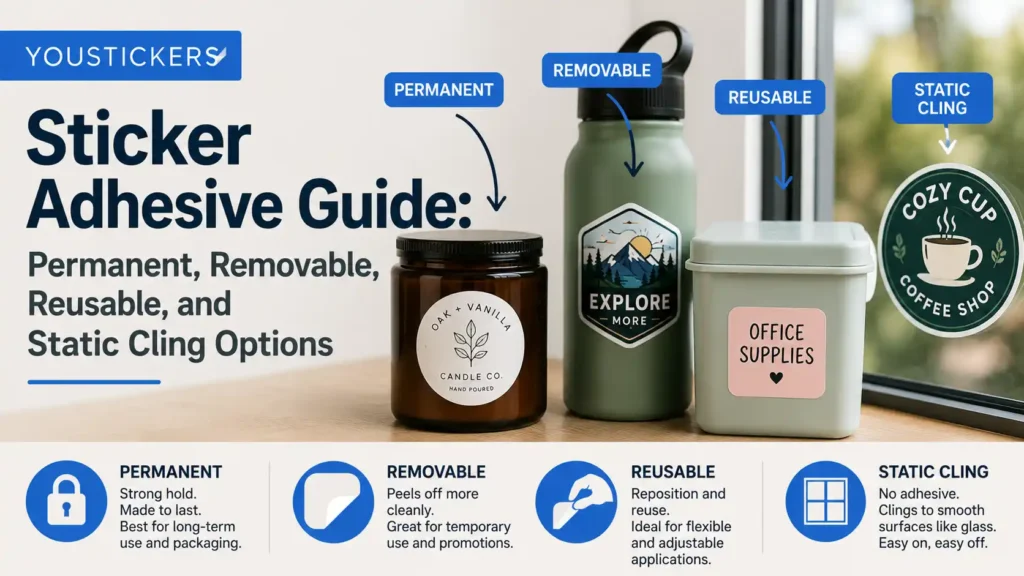
TLDR
- Choose permanent adhesive when the sticker or label should stay in place for regular use, product packaging, bottles, jars, shipping, branding, or outdoor-facing applications.
- Choose removable adhesive when the sticker needs to come off more cleanly, such as bumper stickers, temporary promotions, reusable containers, price labels, or short-term signage.
- Choose reusable or repositionable adhesive when the sticker needs to be moved, adjusted, opened and closed, or reapplied during normal use.
- Choose static cling for smooth glass, windows, mirrors, and short-term displays where you want no adhesive at all.
- No sticker adhesive works equally well on every surface. Clean, smooth, hard surfaces usually perform best.
Sticker adhesive is one of the most important parts of a sticker, even though it is usually the part customers think about last. Artwork gets the attention, but adhesive decides whether the sticker stays flat, peels early, removes cleanly, leaves residue, or works on the surface at all.
The right sticker adhesive depends on the surface, environment, time period, and removal expectations. A candle label, bumper sticker, window cling, laptop sticker, water bottle sticker, reusable container label, and temporary sale decal all need different things from the adhesive.
What Is Sticker Adhesive?
Sticker adhesive is the sticky layer that bonds the sticker or label to a surface. Most common stickers and labels use pressure-sensitive adhesive, which means the adhesive bonds when you press it onto the surface. Pressure-sensitive labels do not need added glue, water, or heat during normal application; the label already carries the adhesive and bonds when pressure is applied.
A typical sticker or label has three basic layers:
- the face material, which is the printed sticker material
- the adhesive, which bonds to the surface
- the release liner, which protects the adhesive until application
The adhesive is not separate from the sticker. It is part of the material system. That is why the same artwork can perform very differently depending on whether it is printed as a permanent label, removable bumper sticker, reusable label, or static cling.
Quick Adhesive Comparison
| Adhesive option | Best for | Removal expectation | Watch out for |
|---|---|---|---|
| Permanent adhesive | Product labels, packaging, water bottles, laptops, boxes, jars, general stickers | Designed to stay on; removal may leave residue or damage the sticker | Not ideal when the customer needs clean removal |
| Removable adhesive | Bumper stickers, temporary promos, price tags, reusable containers, short-term signage | Intended to remove more cleanly than permanent adhesive | May not hold as aggressively on difficult surfaces |
| Reusable / repositionable adhesive | Labels that need adjustment, temporary placement, reclosable items, changing organization systems | Can often be moved or repositioned, depending on the product | Dirt, oil, dust, and repeated handling reduce performance |
| Static cling | Windows, glass doors, mirrors, temporary glass displays | No glue; usually removes without sticky residue | Works best on smooth, clean, non-porous surfaces, especially glass |
Permanent Adhesive
Permanent adhesive is made for stickers and labels that are supposed to stay in place. It creates a stronger bond than removable adhesive and is the standard choice for many everyday sticker projects.
YouStickers’ FAQ notes that adhesive varies by product. Custom stickers, transfer stickers, vinyl lettering, labels, and front-adhesive stickers use permanent adhesive, while custom bumper stickers use removable adhesive.
Choose permanent adhesive for:
- product labels
- jar labels
- bottle labels
- candle labels
- box labels
- shipping labels
- water bottle stickers
- laptop stickers
- equipment labels
- logo stickers
- packaging seals
- brand stickers
- QR code labels
- warning or instruction labels
Permanent adhesive is usually the right choice when the sticker is part of the product, package, or brand presentation. If a label identifies the product, protects a package seal, gives instructions, or carries important customer information, you usually want it to stay put.
Avery describes permanent label adhesive as a strong bond meant to stay in place, often requiring soaking, scraping, or another removal method if the label has to come off later.
When Permanent Adhesive Is the Better Choice
Permanent adhesive is the best choice when removal is not the goal.
Use it when:
- the sticker should stay on for regular handling
- the label is part of retail packaging
- the design goes on a smooth bottle, jar, box, or container
- the sticker may be handled frequently
- the customer is not expected to peel the sticker off later
- the label carries important product, safety, barcode, or QR information
For small businesses, permanent adhesive is usually the safest default for packaging. A coffee bag label, bakery box sticker, cosmetic jar label, candle label, and shipping label all need a reliable bond more than they need easy removal.
The tradeoff is residue risk. Permanent adhesive is not designed to come off cleanly in every situation. If customers are expected to reuse the container, remove the sticker from a car, or peel the label off a gift item, removable adhesive may be a better fit.
Removable Adhesive
Removable adhesive is designed to bond securely enough for the use case but remove more cleanly than permanent adhesive. It is useful when the sticker needs to be temporary or when the surface matters after removal.
Choose removable adhesive for:
- bumper stickers
- temporary promos
- seasonal signage
- price labels
- reusable jars or containers
- short-term event labels
- temporary packaging labels
- rental or shared equipment labels
- labels customers are expected to peel off
Removable does not mean weak. It means the adhesive is intended to remove more cleanly when used on suitable surfaces. Avery’s adhesive guidance explains that removable labels create a secure bond while allowing removal without leaving adhesive residue in typical use.
Removable adhesive is especially useful when the surface has long-term value. A car bumper, painted sign, glass jar, retail display, or reusable box may need to look clean after the sticker is gone.
When Removable Adhesive Is the Better Choice
Removable adhesive is better when the sticker is temporary or when the end user may want the surface back.
Use it when:
- the sticker is promotional, not permanent
- the customer may reuse the container
- the label is applied to a surface that should stay clean
- the sticker goes on a vehicle for a limited time
- the label is seasonal
- the sticker will be changed regularly
- clean removal matters more than maximum hold
Bumper stickers are a good example. A bumper sticker needs to stay on during normal use, but many people eventually want to remove it. That is why removable adhesive makes sense for bumper stickers, while permanent adhesive makes more sense for many product labels.
The tradeoff is hold strength. A removable adhesive may not bond as aggressively as a permanent adhesive on difficult surfaces, tight curves, rough textures, or wet environments. Avery also notes that removable labels may not hold as well as permanent adhesive on curved objects, low-surface-energy plastics, or water-resistant surfaces.
Reusable and Repositionable Adhesive
Reusable and repositionable adhesives sit between permanent and removable use cases. They are designed for stickers or labels that need to be moved, adjusted, opened and closed, or reapplied.
These terms are related but not identical.
Repositionable usually means the sticker can be lifted and adjusted shortly after application or during intended use. Reusable usually means the adhesive can be used more than once, as long as it stays clean and the surface is appropriate.
Choose reusable or repositionable adhesive for:
- labels that need alignment adjustment
- planner or organization stickers
- temporary display pieces
- changing storage labels
- removable product inserts
- reclosable envelopes or bags
- event signage that may move locations
- educational or classroom materials
- short-term retail displays
3M’s removable and repositionable tape guidance gives a useful industry example: low-tack, repositionable acrylic adhesive can allow removal and repositioning on many papers, plastics, foams, and foils, while other adhesive layers may provide a stronger bond on the opposite side. 3M also describes some removable/repositionable constructions as having one high-tack permanent side and one medium-tack removable side for applications that need repositioning, reclosure, or resealing.
For sticker buyers, the practical lesson is simple: “removable” is not always the same as “reusable.” A sticker may peel off cleanly once but not re-stick well. A reusable sticker needs the adhesive and material to support repeated handling.
Static Cling
Static cling is different because it does not use a normal sticker adhesive. A static cling uses smooth vinyl film that clings to smooth, non-porous surfaces, especially glass.
Choose static cling for:
- window displays
- glass doors
- storefront messages
- temporary sales signs
- oil change reminders
- parking permits
- event window graphics
- mirror decals
- seasonal glass decorations
Static cling is useful when you want no glue and no sticky residue. Tekra’s window film guidance explains that static cling does not contain adhesive, can be reused if cleaned and maintained properly, and is easier to apply and remove without chemicals or tools. It also notes that smooth, non-porous surfaces such as windows and glass display cases work best.
Static cling is not the right choice for every temporary sticker. It is mainly a glass and smooth-surface option. It does not perform well on rough, dirty, textured, porous, or flexible materials.
Static Cling vs Removable Adhesive
Static cling and removable adhesive are often confused because both can be temporary. The difference is how they attach.
Static cling uses no glue. It depends on very smooth contact with glass or a similar surface.
Removable adhesive uses a real adhesive. It bonds to the surface, but the adhesive is designed to remove more cleanly than permanent adhesive.
| Need | Better option |
|---|---|
| Temporary window display | Static cling |
| Sticker for a bumper | Removable adhesive |
| Short-term product promo label | Removable adhesive |
| Glass door hours or seasonal message | Static cling or removable adhesive, depending on duration |
| Reusable jar label | Removable adhesive |
| Oil change reminder on glass | Static cling |
| Sticker that must work beyond glass | Removable adhesive |
Tekra notes that low-tack adhesive films are generally more versatile than static cling because they bond to a wider range of surfaces and can perform better in more demanding environments. Static cling is more repositionable, but it is more surface-limited.
Best Adhesive by Surface
| Surface | Usually best option | Notes |
|---|---|---|
| Glass | Permanent, removable, or static cling | Use static cling when no adhesive is preferred |
| Smooth plastic | Permanent or removable adhesive | Some plastics resist adhesive more than others |
| Metal | Permanent or removable adhesive | Clean surface well before applying |
| Painted surface | Depends on paint and removal needs | Use caution with removable claims; test first |
| Sealed wood | Permanent adhesive for longer hold | Raw wood is harder because dust and pores reduce bonding |
| Cardboard / kraft packaging | Permanent adhesive | Great for labels, seals, and branded packaging |
| Water bottles | Permanent adhesive on appropriate material | Clean and dry before application |
| Car bumper | Removable adhesive | Easier eventual removal than permanent adhesive |
| Textured plastic | Test first | Adhesive may not contact enough surface area |
| Rubber or silicone | Avoid when possible | Many adhesives struggle on soft, flexible surfaces |
| Fabric | Not ideal for standard stickers | Use apparel-specific products instead |
YouStickers’ application guidance says stickers adhere best to clean, smooth, hard surfaces such as metal, glass, smooth plastics, finished painted surfaces, and sealed wood. It also lists textured plastics, rubber, silicone, soft-touch coatings, raw wood, fabric, leather, and flexible materials as surfaces to avoid or expect shorter life from.
Surface Prep Matters More Than People Think
Even the right adhesive can fail if the surface is dirty, oily, cold, damp, dusty, or textured.
Before applying stickers or labels:
- clean the surface
- remove dust, oil, and residue
- let the surface dry fully
- apply at room temperature when possible
- press evenly across the full sticker
- avoid touching the adhesive with your fingers
- wait before testing the bond aggressively
Adhesive needs contact. If the sticker is only touching the high points of a textured surface, the bond will be weaker. If dust or oil sits between the adhesive and the surface, the sticker is bonding to the contamination instead of the object.
For product packaging, test the label on the real container before ordering a large run. Avery recommends testing label adhesive on the specific container before a large order and checking performance after 24 to 48 hours.
Common Mistakes to Avoid
Choosing permanent adhesive when the customer needs clean removal
Permanent adhesive is great when the sticker should stay. It is not great when the surface needs to look untouched later. Use removable adhesive for bumper stickers, temporary promotions, reusable containers, and short-term displays.
Choosing removable adhesive when the sticker needs maximum hold
Removable adhesive is not always the right answer for packaging labels, warning labels, outdoor product labels, or high-touch surfaces. If the label needs to stay in place through handling and shipping, permanent adhesive is usually safer.
Treating static cling like a normal sticker
Static cling is not a general-purpose adhesive sticker. It works best on smooth glass and similar surfaces. It is not the right choice for cardboard, rough plastic, raw wood, fabric, or textured packaging.
Assuming reusable means infinitely reusable
Reusable stickers lose performance if the adhesive gets dusty, oily, wrinkled, or touched repeatedly. Store reusable stickers on a clean liner and keep the adhesive side free from debris.
Ignoring low-surface-energy plastics
Some plastics are harder for adhesives to grip. Polypropylene, polyethylene, textured coolers, silicone, rubber, and soft-touch coatings can be difficult. Test before ordering large quantities.
Applying stickers to dirty or cold surfaces
A clean design cannot fix poor application conditions. Cold, moisture, dust, oil, and rough surfaces can all shorten sticker life.
Practical Recommendation
Choose permanent adhesive for most product labels, packaging stickers, water bottle stickers, laptop stickers, and brand stickers where long-term hold matters.
Choose removable adhesive for bumper stickers, temporary promotions, reusable containers, and any project where the customer may want cleaner removal later.
Choose reusable or repositionable adhesive when the sticker needs to be moved, adjusted, opened and closed, or reapplied during normal use.
Choose static cling when the surface is smooth glass and you want a temporary, no-adhesive option.
The safest order-planning question is: “Should this sticker stay forever, come off cleanly, move around, or cling without glue?” Once you answer that, the adhesive choice becomes much easier.
FAQs
What is the best sticker adhesive?
The best sticker adhesive depends on the job. Permanent adhesive is best for long-term stickers and product labels, removable adhesive is best for temporary use, reusable adhesive is best for repositioning, and static cling is best for smooth glass when no glue is wanted.
Are permanent stickers removable?
Permanent stickers can often be removed, but they are not designed for clean removal. Depending on the surface and age of the sticker, removal may leave adhesive residue, damage the sticker, or require heat, soaking, scraping, or adhesive remover.
Do removable stickers leave residue?
Removable stickers are designed to reduce residue, but clean removal depends on the surface, time, temperature, adhesive type, and application conditions. A removable sticker left on a surface for a long time may become harder to remove cleanly.
Are reusable stickers the same as removable stickers?
No. Removable stickers are designed to come off more cleanly. Reusable stickers are designed to be reapplied or repositioned. A sticker can be removable without being reusable.
What surfaces do stickers stick to best?
Stickers usually stick best to clean, smooth, hard surfaces such as glass, metal, smooth plastic, finished paint, and sealed wood. Rough, oily, dusty, flexible, rubbery, or textured surfaces are harder for adhesives.
What is static cling best for?
Static cling is best for smooth glass, windows, mirrors, and temporary displays where you want no adhesive. It is not a good general replacement for permanent or removable stickers on packaging, cardboard, fabric, rough plastic, or textured surfaces.
References
YouStickers FAQ and application guidance were used for YouStickers-specific adhesive and surface recommendations. Avery adhesive guides were used for general permanent, removable, and testing guidance. 3M removable/repositionable adhesive examples were used for industry context. Tekra’s static cling guide was used for static cling and low-tack adhesive comparison.
