
Why this even matters (and why your fingernails are involved)
There are two types of people in the world:
- People who peel stickers like a calm, capable adult.
- People who scratch at a corner until the sticker bends, the backing tears, and the sticker becomes… “abstract art.”
I’ve been both people. Usually in the same minute.
That’s the real reason die cut vs kiss cut stickers isn’t just a nerdy print term. The cut style changes how the sticker looks in your hand, how easy it is to peel, how it survives shipping, and whether it ends up applied neatly or crumpled in a pocket like a tiny regret.
And the secret villain/hero in this story is the backing.
Die cut vs kiss cut stickers: the one-sentence difference
Here it is:
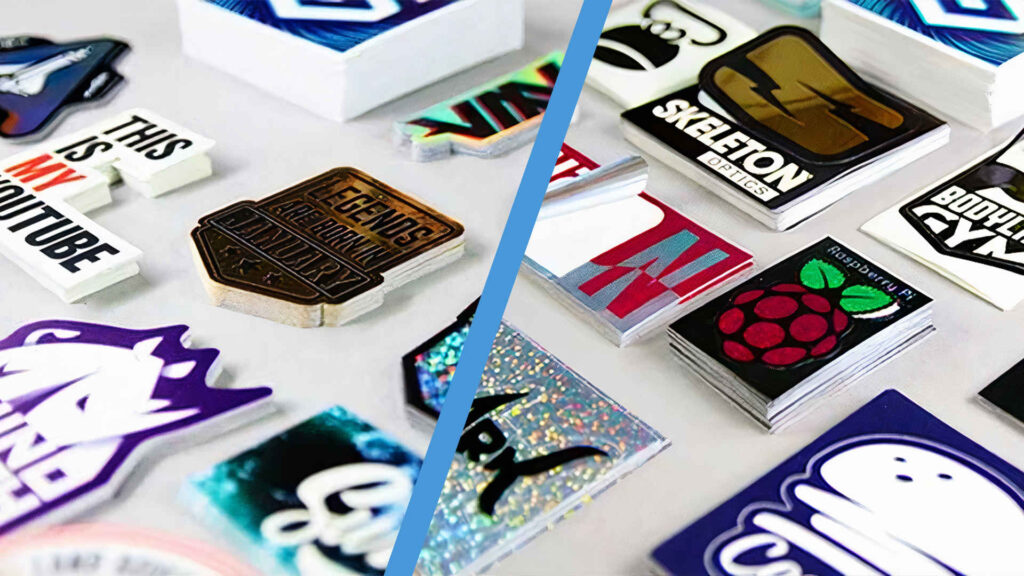
- Die cut = cut all the way through the sticker and the backing. You get an individual sticker shaped exactly like the artwork.
- Kiss cut = cut through the sticker layer, not the backing. The sticker stays on a larger sheet or border of backing.
That’s the core. Everything else—peel speed, edge protection, “why does this feel fancy?”—flows from that.
Also, quick note: people use these terms loosely online. Some shops say “die cut” when they really mean “custom shape.” And some “kiss cut” products are a mix: a kiss cut for the peelable sticker, plus an outer cut that shapes the backing. In plain English: sticker printing loves names almost as much as it loves cutting things.
Backing paper 101: what “release liner” actually does
The backing paper is not just “paper that happens to be there.” It’s usually a release liner—a sheet coated so the adhesive doesn’t bond to it permanently.
That coating is the reason your sticker arrives as a sticker and not as a sad, sticky wad.
This matters because:
- the liner affects how easily the sticker releases
- the liner can protect edges during shipping and handling
- the liner can include features like back slits or crack-back cuts that make peeling easier
So when we talk about die cut vs kiss cut, we’re really talking about “how much liner is left” and “what job the liner is doing.”
Die cut stickers: the “clean edge, no border” look
A die cut sticker is the classic giveaway sticker. It’s cut to the exact outline of your design. No extra square. No border you didn’t ask for. Just the shape.
Why people love die cut stickers
- Premium, finished look. It feels like a complete object, not a piece of a sheet.
- Great for branding and handouts. Easy to toss in orders, include in mailers, or stack on a table.
- Works beautifully for bold shapes. Logos, mascots, icons, big text—this is their natural habitat.
The downside nobody tells you about
Die cut stickers can be annoying to peel if the backing is just a plain, un-slit sheet. Especially if:
- the sticker is small
- the sticker has sharp points or thin bits
- your hands are dry
- you are trying to look cool in front of other humans
That’s why some die cut stickers come with peel-friendly backing features like:
- a back slit (a cut on the backing to start the peel)
- crack-and-peel or crack-back liners (multiple slits so you can “bend and crack” the liner open)
If you’ve ever watched someone peel a sticker in one smooth motion and thought, “wow, must be nice,” there’s a good chance the liner did the heavy lifting.
Kiss cut stickers: easier peeling, more protection, more control
A kiss cut sticker stays on its backing sheet. The sticker layer is cut, but the liner remains intact.
That gives you an extra border of backing around the sticker. And that border is not wasted space. It’s a handle.
Why kiss cut is the easiest peel
That extra border makes it simpler to:
- hold the backing steady
- lift the sticker without bending it
- apply it cleanly without touching the adhesive as much
If you’re doing intricate designs (thin lines, lots of points, small pieces), kiss cut can feel like training wheels in the best way.
Kiss cut also plays well with sticker sheets
Kiss cut is the go-to choice for sticker sheets: multiple stickers on one sheet, each easy to peel.
If you sell stickers, include freebies, or want a “one sheet, many designs” format, kiss cut sheets are just… practical. And “practical” is underrated until you’re packing 200 orders.
Another quiet bonus: extra space
That backing border can sometimes be used for extra info—tiny branding, a URL, a QR code, a “limited run” note—without changing the sticker art itself. Not everyone needs this, but it’s a nice option to have.
How backing affects presentation: sheets vs singles, and why it changes the vibe
A sticker isn’t only judged when it’s stuck to something. It’s judged the moment someone holds it.
Die cut presentation
Die cuts look like little standalone products. Clean silhouette. Easy to scatter across a table. Easy to put in a stack.
If you want your sticker to feel like “the thing,” die cut nails it.
But die cuts can also feel more delicate at the edges in transit. Points and thin parts can get dinged if they’re packed tightly, tossed around, or handled a lot.
Kiss cut presentation
Kiss cuts feel more like a set. Even a single kiss cut sticker has that border, and a sheet feels organized.
Kiss cut sheets are also easier to store, ship, and handle without edge damage because the liner supports the sticker until the moment it’s applied.
So if you’re thinking “I want these to arrive looking perfect,” kiss cut often has an advantage—especially for detailed shapes.
Handling and application: who wins in real life?
Let’s talk about the moment of truth: peeling and sticking.
Die cut wins when…
- you want a sticker that looks “done” the second someone picks it up
- you’re handing them out one at a time
- the design is bold and not too tiny
- you’re using an easy-peel liner (back slit, crack-back, etc.)
Kiss cut wins when…
- you want fast, easy peeling with fewer bent corners
- you have small or intricate artwork
- you’re selling or shipping stickers and want better edge protection
- you want sticker sheets (and your customers like having options)
Also: kiss cut is often friendlier for people who don’t have great dexterity, long nails, or patience. Which is most people, on most days.
Production and cost: why kiss cut is common for labels and high-volume runs
You don’t need to become a manufacturing engineer to order stickers. But one idea helps:
Cutting through the liner (die cut) usually takes more effort and creates more individual pieces to handle. Keeping the liner intact (kiss cut) can be faster and easier to process at scale, especially on rolls or sheets.
That’s one reason kiss cut shows up everywhere in the label world: it stays stable on the liner, it’s easy to peel, and it works with automated application.
For small custom sticker orders, pricing varies by shop and setup. But the production logic is still the same: liner intact = easier handling.
Design tips that will save you from file pain
I’ll keep this simple:
If you choose die cut
- Make sure tiny points and skinny parts are truly necessary. They can cut fine, but they’re more fragile.
- If you want full bleed color to the edge, you need bleed in your artwork so you don’t get accidental white slivers.
If you choose kiss cut
- Decide if you want a tight border or a generous one. More border usually means easier peeling.
- Sticker sheets benefit from clean spacing and consistent margins so everything feels intentional.
Either way, keep your important details away from the cut line. That includes small text and thin outlines.
How to choose: a quick cheat sheet
Choose die cut stickers if you want:
- standalone stickers (no sheet)
- the clean “sticker-shaped sticker” look
- easy handouts and freebies
- strong visual impact for a single design
Choose kiss cut stickers if you want:
- easier peeling (especially for small stickers)
- better edge protection before application
- sticker sheets with multiple designs
- a more organized, retail-friendly presentation
And if you’re still stuck: pick the one that matches how people will receive it.
- Handed one sticker at a time? Die cut.
- Packed, shipped, stored, peeled repeatedly? Kiss cut.
Conclusion
Die cut vs kiss cut stickers comes down to one thing: how much backing you leave behind. But that one thing changes everything—peeling, durability in transit, how the sticker looks in the hand, and how “premium” it feels.
Die cuts are the clean, standalone option. Kiss cuts are the easy-peel, protected, sheet-friendly option.
Neither is “better.” They’re just better at different jobs. Kind of like scissors and a butter knife. Please don’t use a butter knife to cut stickers. I can’t stop you, but i can judge you a little.t both options in detail.
Explore our Custom Sticker Page for our full range of sticker solutions tailored to your needs.
