
TLDR
- Water-resistant stickers can handle light moisture, splashes, and brief contact with water, but they are not meant for soaking, heavy weather, or long wet exposure.
- Waterproof stickers are designed to handle more direct water exposure without the sticker material falling apart or the print smearing under normal use.
- Weatherproof stickers are built for outdoor conditions, which may include rain, sun, temperature changes, scratches, and general exposure.
- For water bottles, coolers, outdoor gear, cars, and packaging that may get wet, vinyl with a protective laminate is usually safer than paper.
- No sticker term is magic. Surface prep, adhesive, laminate, ink, sunlight, heat, chemicals, and how long the sticker stays wet all affect performance.
Waterproof vs Weatherproof vs Water Resistant Stickers: The Simple Difference
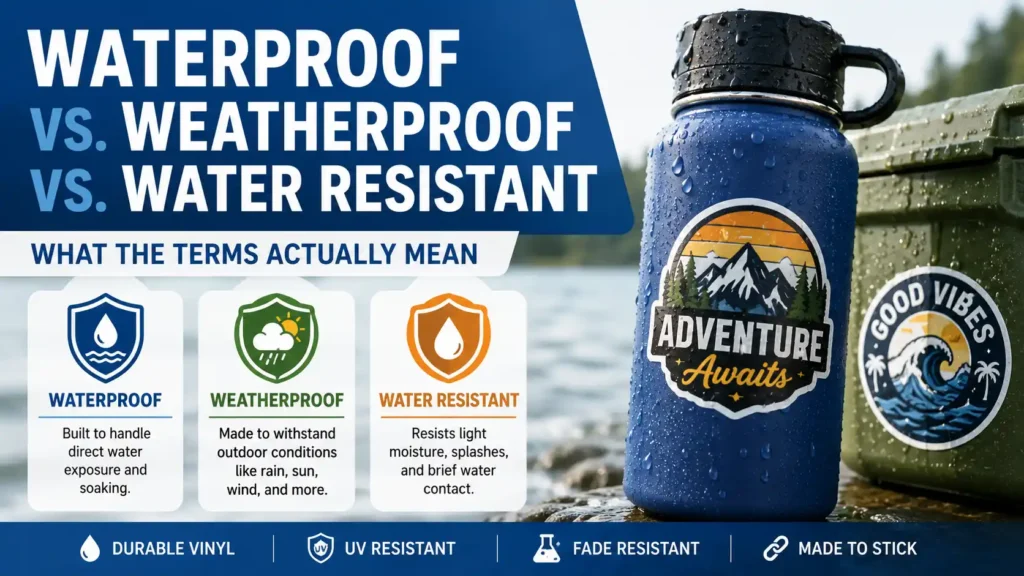
The difference between waterproof vs weatherproof vs water resistant stickers comes down to the type and amount of exposure the sticker is expected to handle.
A water-resistant sticker can handle some contact with water. Think light splashes, damp hands, condensation, or a short brush with moisture. It is not the best choice for long outdoor use, soaking, dishwashing, or products that sit in wet environments.
A waterproof sticker is designed for stronger water exposure. In sticker language, waterproof usually means the sticker material and print construction can tolerate water better than paper or uncoated materials. It does not automatically mean the sticker can survive every kind of submersion, soap, heat, chemical, dishwasher cycle, or long-term wet storage.
A weatherproof sticker is designed for outdoor exposure. Weather includes more than water. Rain matters, but so do sunlight, UV exposure, temperature swings, dirt, handling, scratches, wind, and surface movement. YouStickers describes its custom stickers as made for everyday resistance to water, scratches, and normal outdoor exposure, which is a useful practical way to think about many real-world sticker uses.
The safest rule: water-resistant is for light moisture, waterproof is for water exposure, and weatherproof is for broader outdoor exposure.
Why These Terms Get Confusing
These terms get confusing because people use them differently across stickers, labels, electronics, clothing, packaging, and outdoor gear.
In technical industries, water protection is often tested using specific standards. For example, the International Electrotechnical Commission explains that Ingress Protection, or IP ratings, grade how well an enclosure resists dust and liquids. That kind of system is useful because it separates vague marketing language from tested conditions.
Most custom stickers are not sold with IP ratings. Instead, words like waterproof, water-resistant, and weatherproof are practical material descriptions. They help customers understand whether a sticker is a good fit for a water bottle, product package, window, bumper, cooler, laptop, candle jar, or outdoor tool box.
That is why it helps to ask a more specific question than “Is this sticker waterproof?”
Better questions include:
- Will the sticker get splashed or soaked?
- Will it be used indoors or outdoors?
- Will it face sun exposure?
- Will it be washed by hand?
- Will it touch soap, oil, alcohol, or cleaning chemicals?
- Will the surface be smooth, textured, curved, or flexible?
- Is the sticker decorative, functional, or required to stay readable?
The answer depends on the full use case, not just the word on the product page.
What Water-Resistant Stickers Actually Mean
Water-resistant stickers can tolerate limited moisture. They are usually fine for indoor use, light handling, occasional splashes, or short exposure to damp conditions.
A water-resistant sticker might be fine on:
- notebooks
- laptops
- folders
- retail packaging
- shipping inserts
- dry storage containers
- indoor product labels
- event handouts
- temporary signage
- items that may be touched with damp hands
Water-resistant does not mean the sticker should be soaked. If a label is placed on a bottle that sits in an ice bucket, a jar stored in a cooler, or a container washed repeatedly, water resistance may not be enough.
Avery’s waterproof label material guidance is a helpful comparison point because it separates moisture-resistant durability from more demanding waterproof label use. Avery describes some waterproof label materials as standing up to oils and moisture, while also offering more heavy-duty options for tougher jobs. The lesson for sticker buyers is simple: the level of exposure matters.
Choose water-resistant stickers when moisture is possible but not the main challenge.
What Waterproof Stickers Actually Mean
Waterproof stickers are designed to handle water better than ordinary paper stickers or unprotected printed materials. For most sticker buyers, this means the sticker can be used on surfaces like water bottles, coolers, glass, outdoor gear, packaging, or other items that may get wet during normal use.
YouStickers describes its homepage offering as waterproof vinyl stickers and roll labels in custom sizes, shapes, and quantities. That kind of waterproof vinyl sticker is usually a better choice than paper when the sticker may face spills, condensation, rain, or regular handling.
Still, waterproof should not be treated as unlimited. A sticker may be waterproof in the sense that the face material and print can handle water, while the adhesive, edges, or surface bond may still be affected by soaking, heat, soap, oil, abrasion, or repeated washing.
A waterproof sticker is usually a good fit for:
- water bottles
- coolers
- tumblers
- helmets
- bikes
- outdoor gear
- glass jars
- bath and body packaging
- beverage packaging
- laptops that may see light moisture
- outdoor event stickers
Waterproof stickers are not automatically the best choice for every wet use. If the sticker will be submerged for long periods, scraped, pressure washed, cleaned with chemicals, exposed to oils, or put through a dishwasher, ask more questions before ordering.
What Weatherproof Stickers Actually Mean
Weatherproof stickers are made for outdoor exposure, not just water exposure.
Weather can include:
- rain
- sun
- UV exposure
- wind
- dust
- dirt
- scratches
- heat
- cold
- humidity
- surface expansion and contraction
That is why a weatherproof sticker usually needs more than a water-tolerant face material. It may also need durable vinyl, a suitable adhesive, protective laminate, outdoor-rated inks, and good surface prep.
3M’s graphic protection materials are a useful industry example because their overlaminate and clear protection options are designed to add graphic protection over printed films. The takeaway for sticker buyers is that laminate matters. A protective layer can help shield the print from handling, moisture, scratching, and sunlight better than unprotected print alone.
Weatherproof stickers are usually a good fit for:
- car windows
- bumpers
- outdoor equipment
- tool boxes
- hard hats
- coolers
- bikes
- trailers
- storefront windows
- outdoor signs
- event signage
- construction or service labels
Choose weatherproof when the sticker needs to live outside or handle daily exposure beyond simple moisture.
Quick Comparison: Waterproof vs Weatherproof vs Water Resistant Stickers
| Term | What It Usually Means | Best For | Main Watchout |
|---|---|---|---|
| Water-resistant | Handles light moisture, splashes, or brief contact | Indoor packaging, laptops, notebooks, temporary use | Not meant for soaking or long wet exposure |
| Waterproof | Handles more direct water exposure under normal use | Water bottles, coolers, jars, wet packaging, outdoor gear | Not a guarantee against dishwashers, chemicals, or long submersion |
| Weatherproof | Handles broader outdoor exposure | Cars, windows, equipment, outdoor signs, gear | Sun, heat, surface prep, and abrasion still matter |
Best Choice by Use Case
Best Stickers for Water Bottles
Use waterproof vinyl stickers for water bottles. Water bottles get handled, splashed, chilled, warmed, and wiped down. A paper sticker or lightly water-resistant material may not hold up well.
Avoid tiny details near the edge of the sticker because edge wear can happen faster when a bottle is handled often.
Best Stickers for Product Packaging
Use the material that matches the product environment.
For dry boxes, bags, and general packaging, water-resistant or standard vinyl may be enough. For jars, bottles, bath products, candles, cosmetics, beverages, or refrigerated products, waterproof or weather-resistant label materials are usually safer.
For repeated packaging application, custom labels and roll labels may make more sense than individual sticker singles because roll labels are easier to apply in batches. YouStickers describes its custom labels as resistant to water, sunlight, and scratches, which is helpful for packaging workflows that need more durability than basic paper labels.
Best Stickers for Outdoor Use
Choose weatherproof stickers for outdoor use. A sticker used outside needs to handle more than rain. Sunlight, heat, cold, scratches, and dirt can all affect how long the sticker looks good.
This is where vinyl and laminate become important. A laminated vinyl sticker is usually a stronger choice than uncoated paper for outdoor use.
Best Stickers for Cars
Use weatherproof vinyl stickers for car windows, bumpers, and outdoor vehicle surfaces. Cars face rain, sun, road grime, temperature changes, and washing.
For bumper stickers specifically, adhesive choice also matters. A removable adhesive may be better when the customer may want to remove the sticker later.
Best Stickers for Laptops
Water-resistant or waterproof vinyl stickers can both work for laptops, depending on the design and expected use. Laptops usually do not need full outdoor weatherproofing, but they do need scratch resistance and enough durability for bags, hands, and daily handling.
Best Stickers for Coolers and Outdoor Gear
Choose waterproof or weatherproof vinyl stickers. Coolers and outdoor gear often face wet hands, melting ice, dirt, sunlight, scratches, and rough handling. A stronger sticker construction is usually worth it.
Surface Prep Matters as Much as the Term
Even a waterproof or weatherproof sticker can fail early if it is applied to the wrong surface.
Adhesive bonds better to clean, smooth, dry surfaces. Dust, oil, wax, soap residue, silicone, texture, moisture, and cold temperatures can all reduce adhesion. Curved and flexible surfaces can also create edge lift if the sticker is too large or too stiff for the surface.
Before applying a sticker:
- clean the surface
- remove oil, dust, and residue
- let the surface dry completely
- avoid applying to very cold or very hot surfaces when possible
- press from the center outward
- give the adhesive time to bond before heavy use
A sticker’s water resistance only helps if the sticker is bonded well to the surface.
Common Mistakes to Avoid
Assuming Waterproof Means Dishwasher-Safe
Waterproof does not automatically mean dishwasher-safe. Dishwashers add heat, detergent, pressure, abrasion, and repeated cycles. Those conditions are different from normal splashes or rain.
Choosing Paper for Wet Packaging
Paper labels can be useful for dry products, but they are usually not the safest choice for jars, bottles, cosmetics, bath products, beverages, or refrigerated goods unless the material is specifically made for that environment.
Ignoring Sun Exposure
A sticker can handle water but still fade in harsh sun if the material, ink, or laminate is not suited for outdoor use. Weatherproof is the better term to look for when sunlight matters.
Applying Stickers to Dirty Surfaces
Poor surface prep is one of the most common reasons stickers peel early. Clean and dry the surface before applying.
Using Tiny Text on Outdoor Stickers
Outdoor stickers need to be readable after distance, glare, weather, and wear. Keep text larger, contrast higher, and layouts simpler.
Treating All Vinyl as the Same
Vinyl is a broad material category. Adhesive, laminate, ink, thickness, finish, surface, and use case all affect performance.
Practical Recommendation
Choose water-resistant stickers for light indoor use, dry packaging, notebooks, laptops, and situations where moisture exposure is occasional and minor.
Choose waterproof stickers for water bottles, coolers, wet packaging, bath products, beverage containers, outdoor gear, and items that may get splashed or handled with wet hands.
Choose weatherproof stickers for outdoor use, cars, windows, equipment, tool boxes, coolers, signage, and stickers that need to handle rain, sun, scratches, and temperature changes.
For most customer-facing uses where durability matters, laminated vinyl is usually the safest starting point. For product packaging applied in volume, roll labels may be the better format. For one-off merch, giveaways, water bottles, and laptops, custom vinyl stickers are usually the simpler choice.
FAQs
Are waterproof stickers actually waterproof?
Yes, waterproof stickers are designed to handle water exposure better than paper or unprotected materials. However, waterproof does not mean indestructible. Long submersion, dishwashers, chemicals, heat, oils, and abrasion can still affect the sticker.
Are weatherproof stickers better than waterproof stickers?
Weatherproof stickers are better for outdoor exposure because they are meant to handle more than water. Rain, sunlight, temperature changes, scratches, and dirt all matter outdoors.
Are water-resistant stickers enough for packaging?
Water-resistant stickers can be enough for dry packaging or products with only light moisture exposure. For bottles, jars, bath products, cosmetics, beverages, or refrigerated products, waterproof or weather-resistant materials are usually safer.
Can waterproof stickers go on cars?
They can, but weatherproof vinyl stickers are usually the better choice for cars because vehicles face sun, rain, grime, heat, cold, and washing.
Do waterproof stickers stick to wet surfaces?
Usually, stickers should be applied to a clean, dry surface. A waterproof sticker may resist water after it is applied, but applying it to a wet surface can interfere with the adhesive bond.
What is the best sticker for outdoor use?
A weatherproof vinyl sticker with a protective laminate is usually the best choice for outdoor use. The exact best option depends on the surface, sunlight, temperature, expected lifespan, and how much abrasion the sticker will face.
