
TLDR
- Choose vinyl stickers for water bottles, laptops, outdoor use, merch, cars, coolers, hard cases, and anything that needs to last.
- Choose paper stickers for short-term indoor use, dry packaging, event name tags, simple product labeling, and lower-cost bulk handouts.
- Vinyl usually costs more than paper, but it is more durable, more moisture-resistant, and better for handled surfaces.
- Paper can look clean, natural, and cost-effective, but it is not the safest choice for wet, oily, outdoor, or high-friction use.
- For most customer-facing brand stickers, laminated vinyl is the safer all-around option.
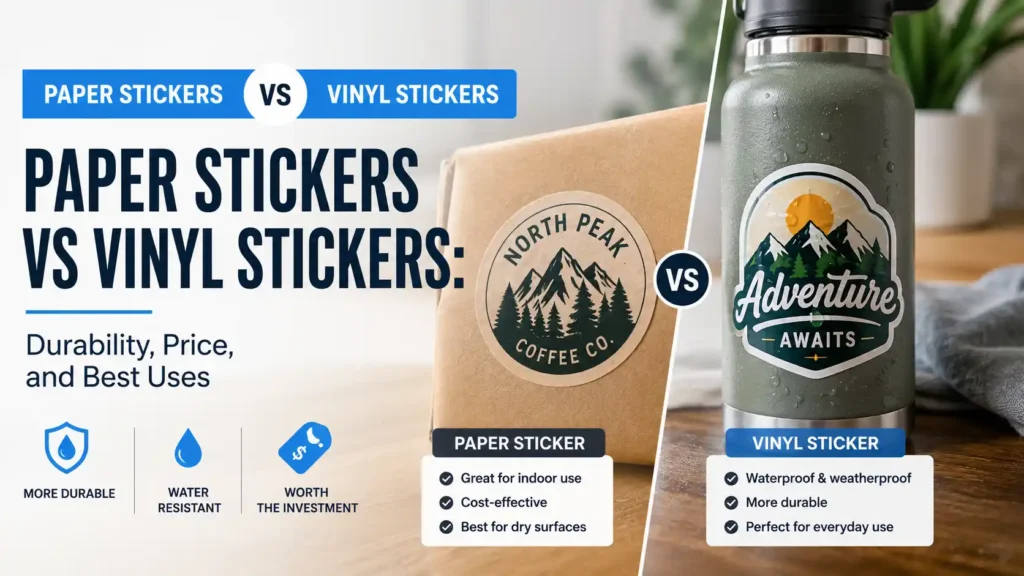
The choice between paper stickers vs vinyl stickers mostly comes down to durability, price, and where the sticker will be used. A paper sticker can be a smart choice for dry indoor packaging or short-term use. A vinyl sticker is usually better when the sticker needs to handle water, sunlight, scratching, bending, or regular handling.
This guide explains the practical differences between paper stickers and vinyl stickers so you can choose the right material before ordering.
Paper Stickers vs Vinyl Stickers: Quick Comparison
| Feature | Paper Stickers | Vinyl Stickers |
|---|---|---|
| Best for | Indoor packaging, short-term labels, dry use | Laptops, water bottles, outdoor use, merch, durable labels |
| Durability | Lower | Higher |
| Water resistance | Low unless specially coated | Better, especially with laminate |
| Outdoor use | Not recommended for most uses | Usually the better choice |
| Feel | Lightweight, paper-like, natural | Smooth, flexible, more durable |
| Price | Usually lower | Usually higher |
| Print look | Great for simple packaging and natural branding | Strong color, clean finish, better protection |
| Best surfaces | Paper bags, boxes, envelopes, dry containers | Bottles, laptops, cars, coolers, windows, cases, packaging |
| Main risk | Wrinkling, tearing, scuffing, moisture damage | Higher cost than paper |
If the sticker is going somewhere dry and temporary, paper may be enough. If the sticker needs to last, vinyl is usually worth the upgrade.
What Are Paper Stickers?
Paper stickers are printed on a paper-based face material with adhesive on the back. They are common for packaging labels, envelope seals, planner stickers, price labels, short-term product labels, event labels, and dry indoor applications.
Paper stickers can look great. They often have a softer, more natural feel than vinyl, especially when used on kraft boxes, bakery bags, handmade goods, stationery, candles, soaps, and boutique packaging. Some paper label materials can be coated for better print quality or improved resistance to humidity, heat, or friction, but the base material is still paper. UPM Adhesive Materials notes that paper label face materials are valued for printability, aesthetics, and use across retail, pharmaceutical, healthcare, and packaging applications.
Paper stickers are a good fit when the sticker is not expected to survive moisture, outdoor exposure, repeated handling, or abrasion.
What Are Vinyl Stickers?
Vinyl stickers are made from a plastic-based film rather than paper. That gives them a smoother feel, more flexibility, and better resistance to moisture and wear. Vinyl is commonly used for laptop stickers, water bottle stickers, bumper stickers, window decals, brand stickers, hard hat stickers, product packaging, outdoor labels, and merch.
For YouStickers, custom stickers are printed on durable vinyl with custom sizes, custom shapes, free online proofs, and no minimums. YouStickers also states that its custom stickers are printed on durable vinyl and finished with matte or gloss laminate, while roll labels are produced on packaging-focused materials.
That laminate matters. Vinyl by itself is helpful, but a protective laminate can improve scratch resistance, finish, and everyday durability. For customer-facing stickers that need to last, laminated vinyl is usually the more dependable choice.
Durability: Which Lasts Longer?
Vinyl stickers are more durable than paper stickers in most real-world uses.
Paper stickers can tear, wrinkle, scuff, absorb moisture, or lose their clean appearance when they are handled often. They are best for short-term indoor uses where the sticker will stay dry and relatively protected.
Vinyl stickers are better for surfaces that are touched, washed, moved, packed, shipped, or exposed to changing conditions. Film label materials are generally more moisture-resistant and tear-resistant than paper label materials, and UPM describes film labels as a more durable alternative to paper for moisture, oils, sun, fading, and flexible packaging needs.
Choose vinyl when the sticker will go on:
- laptops
- water bottles
- coolers
- helmets
- cars
- windows
- hard cases
- outdoor equipment
- reusable containers
- tools
- retail products that may face moisture or handling
Choose paper when the sticker will go on:
- paper bags
- envelopes
- bakery boxes
- dry product packaging
- short-term event materials
- indoor organization labels
- temporary promotions
- low-contact packaging
The simplest rule: if the sticker needs to survive use, choose vinyl. If the sticker only needs to look nice indoors for a short time, paper may work.
Water, Moisture, and Outdoor Use
Moisture is the biggest difference between paper and vinyl.
Paper stickers are not the safest choice for products that may be refrigerated, wiped down, stored in bathrooms, shipped in humid conditions, or handled with wet hands. Even when paper is coated, moisture can still be a problem depending on the material, adhesive, ink, and finish.
Vinyl and other film materials are better when water resistance matters. Avery explains that waterproof labels are designed for prolonged water exposure, while water-resistant labels are better for splashes, condensation, and light moisture. Avery also notes that waterproof labels are useful for food and beverages, bath and body products, outdoor products, and other items that may contact moisture while needing to remain legible and adhered.
For water bottles specifically, YouStickers recommends laminated white vinyl as the safest choice for most reusable bottle stickers because it is durable, waterproof, and gives the artwork a solid white base for readability.
Use vinyl for wet or outdoor use. Use paper only when the sticker will stay dry.
Price: Are Paper Stickers Cheaper Than Vinyl Stickers?
Paper stickers are usually cheaper than vinyl stickers. That is one of their biggest advantages.
Paper can be a smart option when you need a large quantity of indoor labels, packaging seals, price stickers, or simple short-term promotional stickers. If the sticker does not need to last, paying more for vinyl may not be necessary.
Vinyl usually costs more because the material is more durable and is often paired with a protective laminate. That extra cost can be worth it when the sticker represents your brand on a customer’s laptop, bottle, car, toolbox, storefront window, or reusable product.
Think about price this way:
- Paper is cheaper upfront.
- Vinyl is usually better value when the sticker needs to last.
- Reordering failed paper stickers can cost more than choosing vinyl the first time.
- For giveaways and merch, durability affects how people feel about the brand.
If the sticker is disposable packaging, paper can make sense. If the sticker is something the customer may keep, vinyl is usually the better investment.
Best Uses for Paper Stickers
Paper stickers are best for indoor, dry, low-contact uses.
Good paper sticker uses include:
- bakery box seals
- envelope seals
- paper shopping bags
- dry food packaging
- candle warning labels, when appropriate for the packaging and use
- planner stickers
- short-term event stickers
- product price labels
- thank-you stickers
- handmade product labels
- shipping insert stickers
- retail tags and simple indoor labels
Paper also fits brands that want a natural, soft, handmade, kraft, or stationery-style look. A matte paper sticker on a kraft box can feel warmer and more organic than a glossy vinyl sticker.
Paper is not the best fit for water bottles, cars, outdoor gear, shower products, oily containers, cold beverage bottles, or anything likely to get wet.
Best Uses for Vinyl Stickers
Vinyl stickers are best for durable, customer-facing, or long-term use.
Good vinyl sticker uses include:
- logo stickers
- laptop stickers
- water bottle stickers
- bumper stickers
- outdoor decals
- window stickers
- hard hat stickers
- cooler stickers
- tool box stickers
- skateboard or helmet stickers
- merch stickers
- event giveaways
- small business brand stickers
- product labels that need better moisture resistance
Vinyl is also a strong choice when the sticker is part of the customer experience. If someone gets a sticker with an order and puts it on a laptop or bottle, that sticker becomes a small brand impression. A durable sticker that stays clean and readable usually creates a better impression than one that scuffs, curls, or wrinkles.
Which Looks Better?
Neither material is automatically better-looking. They create different effects.
Paper stickers can feel soft, simple, natural, and handmade. They are good for packaging that should feel warm, organic, minimal, or boutique. Paper can work especially well on kraft packaging, envelopes, jars used in dry settings, and short-term retail packaging.
Vinyl stickers feel smoother and more durable. They are better when you want bold color, a clean edge, a polished finish, or a sticker that feels like merch. Matte vinyl can look more subtle and modern, while gloss vinyl can make colors feel brighter and more vibrant.
Choose paper for a natural packaging feel. Choose vinyl for a more durable, polished, long-lasting sticker.
Practical Recommendation
For most general sticker orders, choose vinyl. It is the safer all-purpose choice for logos, giveaways, laptops, water bottles, outdoor use, merch, and customer-facing brand stickers.
Choose paper when the sticker is indoor, dry, short-term, lower-contact, and price-sensitive. Paper is a good choice for packaging seals, simple labels, stationery, event labels, and short-term promotional use.
For small businesses, a mixed approach often works best:
- Use paper stickers for dry packaging and disposable seals.
- Use vinyl stickers for brand handouts, merch, laptops, bottles, and long-term customer use.
- Use roll labels when you are applying labels to many products in a packaging workflow.
- Use custom vinyl stickers when the sticker itself is meant to be kept, displayed, or used on a personal item.
The best material is the one that matches the job. Paper is practical for dry, short-term use. Vinyl is better when durability matters.
Common Mistakes to Avoid
Choosing paper for water bottles
Paper stickers are not the right choice for reusable water bottles. Bottles get wet, handled, washed, and carried in bags. Use laminated vinyl instead.
Assuming vinyl always means indestructible
Vinyl is more durable than paper, but the finish, laminate, adhesive, surface, and application still matter. A poorly applied sticker can fail even if the material is good.
Using paper outdoors
Paper can break down quickly outside. Rain, sunlight, humidity, and temperature changes are hard on paper stickers.
Picking the cheapest option without considering use
A lower-cost paper sticker can be a smart choice for packaging, but it can be a bad choice for merch. Match the material to the expected lifespan.
Ignoring surface texture
No sticker material loves dusty, oily, rough, damp, or heavily textured surfaces. Clean, smooth, dry surfaces give both paper and vinyl a better chance to adhere well.
Using tiny text on the wrong material
Small text can be harder to read if the material wrinkles, scuffs, or absorbs moisture. For important labels, choose a material and size that keep the text readable.
FAQs
Are vinyl stickers better than paper stickers?
Vinyl stickers are better for durability, moisture resistance, outdoor use, and handled surfaces. Paper stickers are better for dry indoor uses where lower cost or a natural paper feel matters more than long-term durability.
Are paper stickers waterproof?
Most paper stickers are not waterproof. Some coated paper materials can handle limited humidity or light resistance, but paper is not the safest choice for wet, outdoor, or heavily handled applications.
Are vinyl stickers waterproof?
Many vinyl stickers are water-resistant or waterproof depending on the material, ink, laminate, adhesive, and production method. For wet use, laminated vinyl is usually the safer choice than unlaminated material.
Which is cheaper, paper or vinyl stickers?
Paper stickers are usually cheaper than vinyl stickers. Vinyl typically costs more because it is more durable and often includes a protective finish.
Should I use paper or vinyl for packaging?
Use paper for dry indoor packaging, envelope seals, bakery boxes, and short-term labels. Use vinyl or packaging-focused film labels when the product may face moisture, refrigeration, oils, handling, or outdoor exposure.
Should I use paper or vinyl for logo stickers?
Use vinyl for most logo stickers, especially if they will be handed out, sold, used as merch, or placed on laptops, water bottles, cars, or outdoor gear. Paper is fine for temporary indoor branding or packaging seals.
