
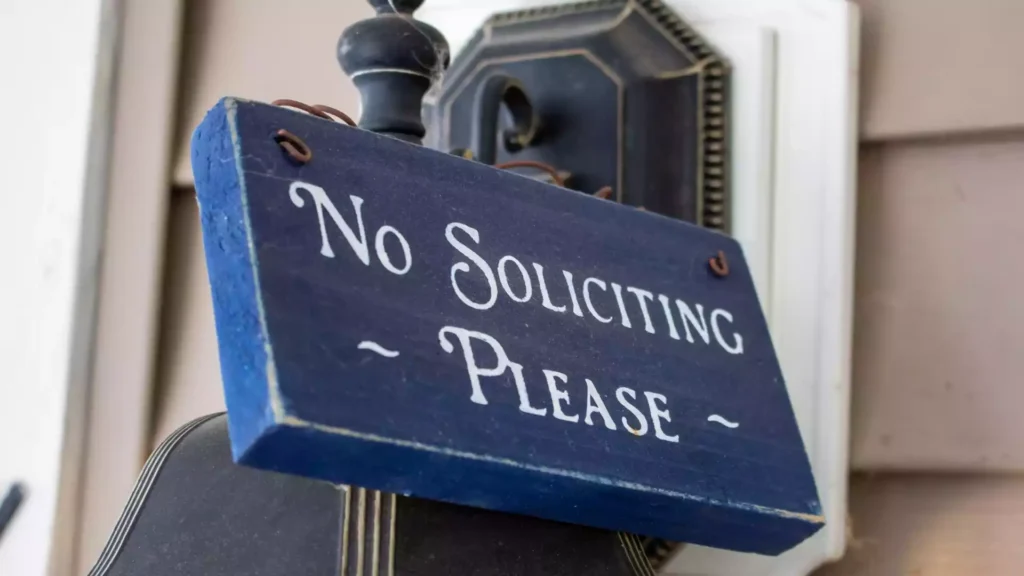
If you’ve ever been mid-meeting, mid-nap, mid-finally got the baby down, and someone rings the doorbell to “share a quick offer,” you already understand the appeal of a No Soliciting door sticker.
The honest truth: they work — just not on everyone. The goal isn’t perfection. The goal is to reduce interruptions dramatically by filtering out the people who are following rules (and most are).
This guide covers:
- whether no soliciting stickers actually reduce knocks
- the best wording (polite, firm, and “no loopholes”)
- where to place it so it gets seen before they ring
- which materials hold up outdoors and clean up easily
- what to do if people still ignore it
Do “No Soliciting” door stickers work?
Yes — for the people you’re trying to filter
Most door-to-door reps, fundraising groups, and service canvassers are trained to look for signs because (1) it saves time, and (2) some cities have rules that require it. When your sticker is obvious and unambiguous, it’s a fast “skip this house” cue.
No — not for the 10–20% who ignore everything
Some will knock anyway:
- they “didn’t see it”
- they claim “I’m not soliciting, I’m just…” (appointment setting, surveys, “information,” etc.)
- they’re working aggressively
- they’re not allowed to be doing what they’re doing in the first place
So think of a sticker as a high-leverage deterrent, not a force field.
The #1 reason No Soliciting stickers fail: wording loopholes
If your sticker only says “No Soliciting,” you’ll eventually get:
“Oh, I’m not soliciting — I’m just here to tell you about…”
That’s why the best “works in real life” signs do two things:
- Say what you mean
- Close the loopholes
Here are plug-and-play options.
Best No Soliciting wording (copy/paste templates)
Option A: Polite, clear, effective
- NO SOLICITING
Please do not knock or ring doorbell. Thank you.
Option B: Firm, still not hostile
- NO SOLICITING
No sales • No fundraising • No surveys
Do not knock or ring.
Option C: “No loopholes”
- DO NOT KNOCK OR RING
No soliciting. No sales. No promotions.
No religion. No politics. No flyers.
(Use this if you’re getting the “I’m not selling” routine.)
Option D: Apartment / shared building friendly
- NO SOLICITING
Residents only. Deliveries welcome.
No door-to-door sales or fundraising.
Option E: Business / office version
- NO SOLICITING
Appointments only.
Please contact us by phone/email.
Tip: If you only want to block sales but allow neighbors/causes, skip the religion/politics line and stick to “No sales / no fundraising / no surveys.”
Where to place a No Soliciting sticker so it actually gets read
Placement matters more than size.
Best placement (highest compliance)
- Right next to the doorbell (or directly above it)
- At eye level on the door or door-side glass panel
If they have to reach the doorbell before noticing your sticker, you’ve lost the game.
Good placement (when the door has texture or glass you don’t want to cover)
- On the door frame
- On the side light (the narrow glass panel next to the door)
- On the storm door (if it’s flat and clean)
For gates, long driveways, or porch approach
If people walk a long way to reach your door, add a second sign:
- near the gate latch
- on the front fence
- near the path entry
This prevents the “well I already walked all the way up here…” knock.
Size and readability: what actually works on a front door
Most people overthink this. You need readable at 3–6 feet, not billboard-sized.
A safe “works for almost everyone” range:
- 3” × 4” (small but readable if high-contrast)
- 4” × 6” (sweet spot for most doors)
- 5” × 7” (best if you have multiple lines/categories)
Design rules that matter:
- High contrast (black on white or white on black)
- Big headline (“NO SOLICITING” or “DO NOT KNOCK”)
- Simple icons (optional) — a bell with a slash can help
- No tiny paragraphs (nobody reads them)
Materials that feel “legit” and survive weather
A front door sticker lives in the real world:
sun, temperature swings, fingerprints, cleaning sprays, rain/snow, and occasionally someone trying to peel it.
Here’s what holds up.
Best for most homes: durable vinyl + laminate
- Vinyl gives you flexibility and outdoor durability.
- Laminate protects the print and helps prevent scuffing.
Matte vs gloss laminate
- Matte: clean, modern, easier to read in direct sunlight (less glare)
- Gloss: classic, punchy, slightly more “sticker-y”
Permanent vs removable adhesive
- Permanent: best if you want it to stay put for years
- Removable: better if you rent, plan to move soon, or want seasonal changes
Clear stickers (when you want it subtle)
Clear can look great on glass, but readability can suffer. If you go clear:
- use solid, high-contrast ink
- consider a white ink underlayer (so text stays visible)
Are No Soliciting door stickers legal?
In most cases, yes — it’s generally legal to post a “No Soliciting” notice on your own door, window, or entryway. You’re simply giving clear notice that you don’t want uninvited sales pitches or canvassing at your home.
Where it gets more nuanced is enforcement. A sticker doesn’t magically create a universal law, but in many cities and counties it does have real teeth because local ordinances specifically treat a posted “No Soliciting” sign as formal notice. In those places, solicitors are required to check for posted notices and not knock or ring if a sign is present — and ignoring it can be a violation.
A couple of important caveats:
- Rules vary by location. Some areas regulate only commercial solicitation; others also cover fundraising, advocacy, or canvassing. Definitions matter (soliciting vs. canvassing vs. peddling).
- Free speech isn’t the same as “must listen.” Even where political/religious door-to-door activity has strong First Amendment protections from government overreach, homeowners still have a well-recognized right to refuse engagement and post notice that they don’t want visitors.
- If someone ignores your sticker: the practical move is to calmly ask them to leave. If they refuse, or repeatedly return, that can cross into ordinance violations and/or trespass depending on local law. Use your local non-emergency line if you need to escalate.
Bottom line: A “No Soliciting” sticker is usually legal, often supported by local rules, and almost always useful — even when it’s not perfectly enforceable everywhere.
“Do they work legally?” A realistic, non-lawyer answer
This varies by city/state, so here’s the practical version:
- In many places, door-to-door solicitation is regulated (permits, hours, ID, etc.).
- Some local ordinances explicitly say solicitors must check for “No Solicitation” signs and treat the sign as notice that the resident does not want solicitation.
- Enforcement depends on local rules and how willing the city is to ticket or revoke permits.
So: a sign can help you both socially (deterrence) and procedurally (clear notice), but it’s not guaranteed enforcement everywhere.
(Not legal advice — if you care about enforceability, look up your city/county “solicitation ordinance” and see how they define soliciting and posted notice.)
How to make your sticker look professional (not homemade)
If you want it to look like something a real business/HOA would issue:
- Use one font (two max)
- Use title case or all caps, not mixed styles
- Keep margins generous (don’t cram)
- Use a simple icon, not clip-art chaos
- Pick a standard shape (rectangle with rounded corners is perfect)
- Consider adding a subtle line like “Thank you” (it reads less aggressive)
What to do if people still ignore your sticker
If knocks continue, you’re usually dealing with a script loophole or someone who doesn’t care.
Here are escalation options that don’t require drama:
- Upgrade wording to “DO NOT KNOCK OR RING” (this closes the “I’m not soliciting” loophole)
- Add “No flyers” if you’re getting door hangers
- Add a second sticker at the walk-up point (gate/fence/path)
- If your area has permitting rules, consider reporting repeat offenders to your city’s non-emergency line (especially if they’re out of allowed hours)
And if you do answer the door, a simple script works:
“We don’t accept any solicitation. Please remove us from your list.”
Close the door. No debate. The goal is not to win an argument — it’s to end the interaction quickly.
FAQs
Is “No Soliciting” the same as “No Trespassing”?
Not necessarily. “No Soliciting” is about door-to-door approaches; “No Trespassing” is broader. Some cities treat “No Soliciting” as formal notice for solicitation purposes. Local definitions vary.
Should I include religion and politics?
Only if that’s what you actually want to block. If you don’t want any uninvited door interaction, it’s useful. If you only want to stop sales calls, keep it focused.
Where’s the best spot if I have a Ring/Nest doorbell?
Right next to the button, at eye level. If they can press the button before they read it, it’s too late.
Will it damage paint or leave residue?
Most quality vinyl stickers remove cleanly from smooth surfaces, but long-term adhesion can leave residue depending on paint type and exposure. If you rent or want easy removal, choose removable adhesive.
References
Examples of municipal ordinances treating “No Solicitation” signs as notice and requiring solicitors to check for posted signs: American Legal Publishing+1
